


On Wednesday, September 9, Wessal Khader (THE GO-TO-MARKET GENIUS) and I are teaching a free 90-minute masterclass where we will walk through exactly how to uncover, build, and price the offer you need to make for your business right now.
Register for Oper(AI)ting Live here: Even if you cannot attend live, register anyway, and we’ll send you the recording.
In 2019, investor Li Jin published an influential essay about what she called the “Passion Economy.” The promise was compelling: the internet would allow individuals to monetize their unique skills, knowledge, and personality without waiting for an employer, publisher, media company, or other gatekeeper to give them permission.
A year later, Jin was writing in Harvard Business Review that the creator economy needed a middle class. The same ecosystem that promised economic independence had already begun producing a familiar pattern: a small number of enormous winners and a much larger group working constantly to make the economics work.
The problem was not that the creator economy failed.
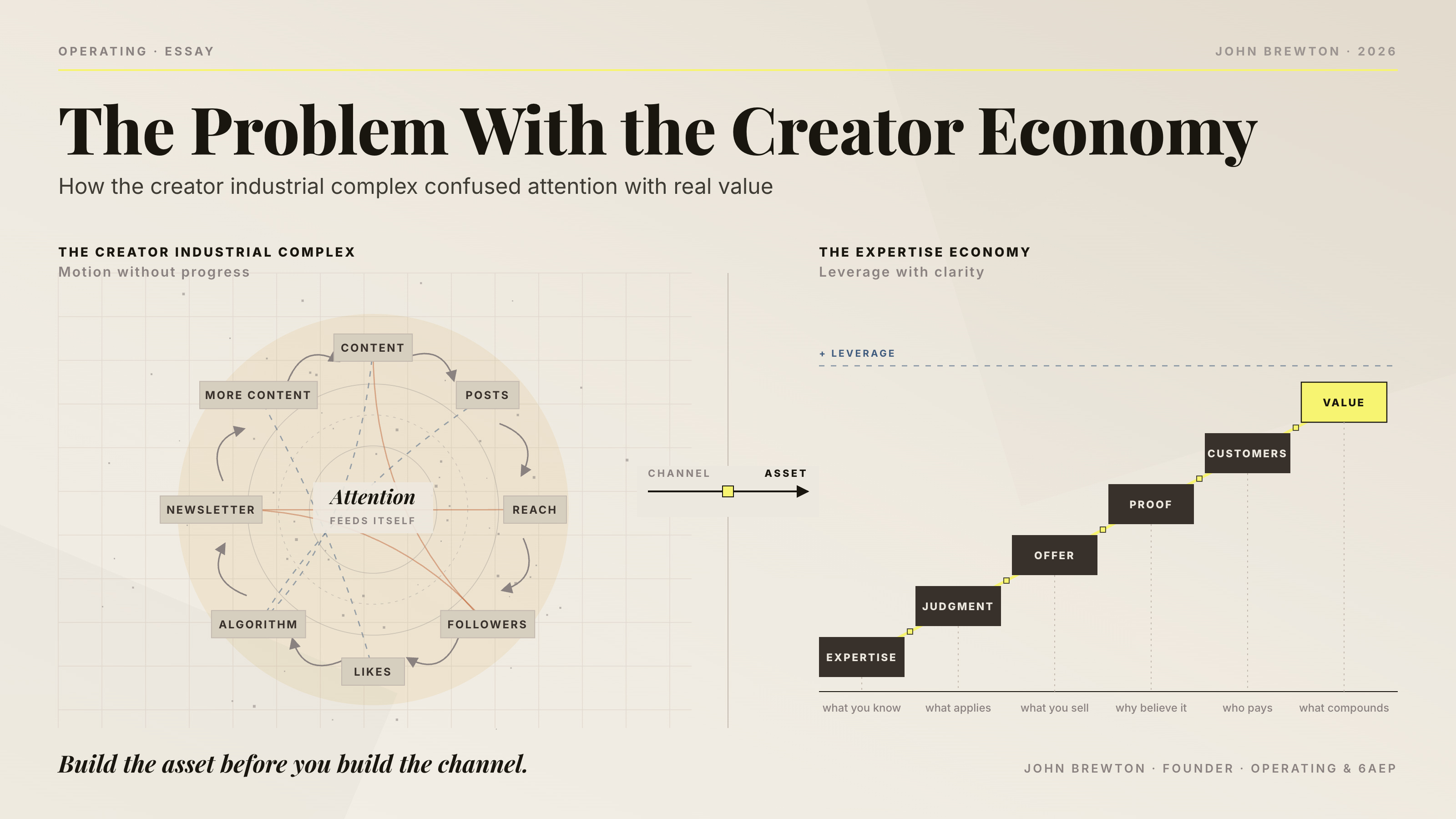
The problem was that, somewhere along the way, we confused the value as being the distribution system, rather than what was being distributed.
Mistake Number One: Building the Channel Before the Offer
Audience building solved a real problem. Distribution used to be scarce. Publishers owned it. Networks owned it. Employers and institutions often decided whose ideas, expertise, and work reached the market.
Social platforms changed that. They gave almost anyone the ability to publish, build an audience, create trust, and eventually transact directly with the people they reached.
But an industry inevitably formed around getting better at the mechanism itself.
Content about making content.
Newsletters about growing newsletters.
Courses about launching courses.
Creators teaching people how to become creators.
Nadia Asparouhova described this years ago as a “creator industrial complex”: An ecosystem that risks becoming increasingly dedicated to perpetuating creation itself rather than helping people accomplish something more valuable through it.
Media scholar Brooke Erin Duffy has another useful concept for what this produces: “aspirational labor.” People perform enormous amounts of work today (publishing, networking, promoting, building) in anticipation of income, opportunity, or status arriving later.
There are people who teach these skills extraordinarily well. I have learned from them myself. Justin Welsh, Chris Donley, Will McTye, and others have built real expertise around distribution and deliver ridiculous value to the people who buy from them.
They are not the problem.
The problem is what the rest of us inferred from their success.
We began teaching experienced professionals that before they could build a business, they first needed to become creators. Learn the algorithm. Post every day. Find three content pillars. Grow the newsletter. Reach 10,000, 20,000, 30,000 followers. Then, once enough people were paying attention, figure out what to sell them.
That sequence is backwards for a huge number of people.
The creator economy taught us to overvalue what we learned last year and undervalue what took us twenty years to learn.
My Story: How I Made All These Mistakes
I know this because I made almost every mistake I just described. Two and a half years ago, I had a little over 500 LinkedIn connections and decided I was going to post every day. I studied content, built relationships with other creators, took Justin Welsh’s LinkedIn MBA and Ship 30 for 30, and later invested $5,000 in Chris Donley’s Creator Accelerator, one of the best investments I made during that period.
I learned how to make content. I learned how to grow. Over the next two and a half years, my work generated more than 30 million LinkedIn impressions and helped me build a bestselling Substack newsletter, Operating by John Brewton. But I made one enormous mistake: I assumed that if I built the audience, the clients would come. For the first 18 months, I had neither a clear offer nor even a clear enough purpose for the newsletter.
The frustrating part is that the most valuable offer I make today was available to me before any of that growth happened. I spent my twenties studying economics at Harvard and the University of Chicago, my thirties helping build, scale, optimize, and eventually sell an industrial distribution business with my father, and the last six years consulting with manufacturing companies, B2B businesses, and technology firms. My real expertise is operational optimization as a means of improving financial performance, not content creation. I love this creator ecosystem, and coaching solopreneurs inside it has become some of the most rewarding work I do, but the thing I am still paid best to do is the thing I spent twenty years learning. The money I left on the table came from confusing the skill I had recently learned to distribute with the expertise I had already earned.
The economics were never as democratic as the distribution
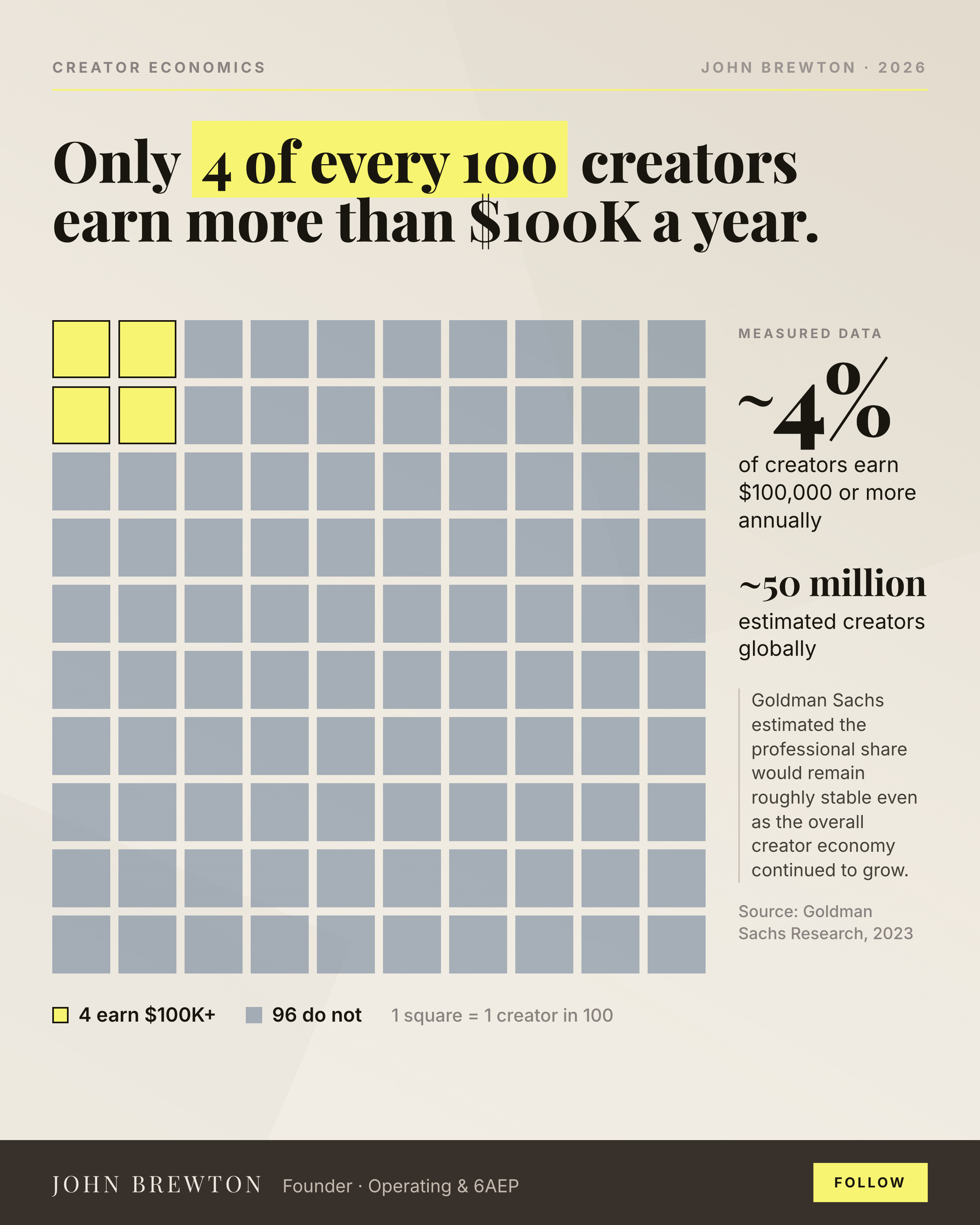
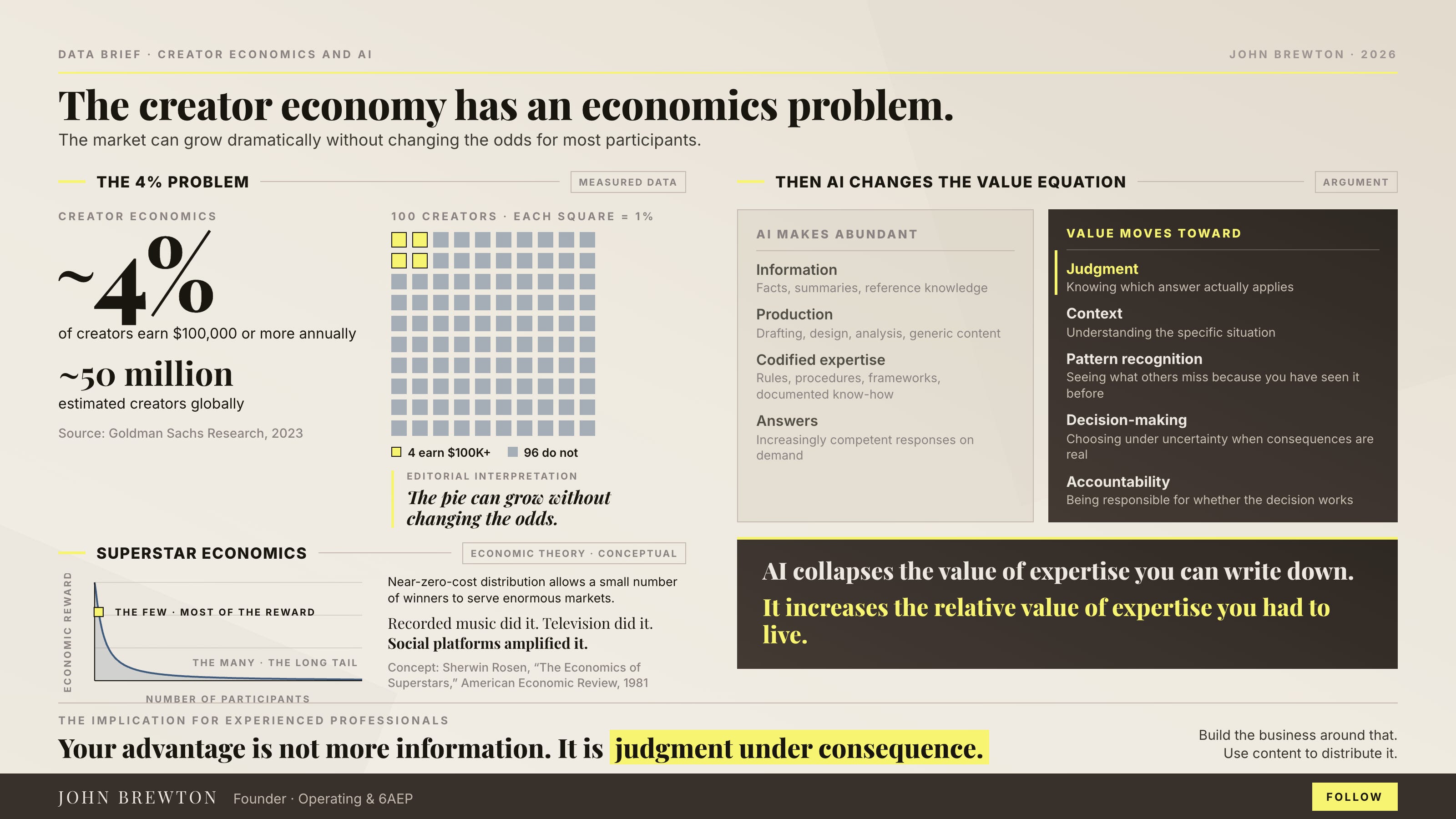
Goldman Sachs estimated that there were roughly 50 million creators globally in 2023 and that only about 4% earned $100,000 or more annually. More importantly, Goldman expected that professional share to remain roughly stable even as the overall creator economy grew dramatically.
That distribution should not surprise us.
In 1981, economist Sherwin Rosen described the “economics of superstars.” When technology allows one person’s output to be distributed to an enormous market at almost no marginal cost, relatively small differences in performance can produce enormous differences in income.
Recorded music did it.
Television did it.
Social platforms amplified it again.
The pie can grow while the odds for the median participant barely move. That does not mean audience building is irrational. CreatorIQ’s 2026 research on more than 5,000 creators found follower and subscriber counts remain strongly related to income. Distribution still compounds, and a large audience can be an extraordinarily valuable asset.
But for an experienced professional, there is a different question worth asking:
Why enter a superstar lottery before attempting to monetize an economic asset you already possess?
The Game Has Changed
The creator economy was built during a period when distribution, production, business infrastructure, and access to information were all expensive.
Every one of those constraints has weakened.
Recommendation systems increasingly distribute individual ideas beyond an existing follower graph. A sufficiently relevant piece of content can reach people who have never heard of you. Software has collapsed much of the infrastructure once required to operate independently: billing, CRM, scheduling, research, publishing, payments, delivery, and customer communication.
Andreessen Horowitz was already writing in 2021 about lawyers, recruiters, consultants, and other professionals “going solo,” with software beginning to replace much of the infrastructure that a traditional firm once provided.
That should have changed the playbook. Instead, we kept handing professionals the entertainer’s model. Become visible first. Become valuable later.
But a 45-year-old operator with 22 years of experience does not begin at zero because she has 400 LinkedIn followers. She may have spent two decades solving problems companies were willing to pay millions of dollars to address.
Her audience might be small. But her economic value is not.
Operating Stories: The $20 Billion Swing - How Uber turned losses into a cash machine.
AI Was Supposed to Kill Consulting. Instead It Has Started a Golden Age.
The Quiet Builders Are Coming. Great Companies Will Build Around Them.
The AI Of It All…
There is an easy version of the AI argument that says expertise is becoming more valuable. The research is more complicated.
Harvard Business School professor Karim Lakhani and his coauthors argue that AI is making many forms of expertise abundant. Economist David Autor has similarly argued that AI may allow more workers to perform tasks that previously required highly paid experts. They are probably right.
AI is rapidly collapsing the value of expertise that can simply be written down.
Facts.
Procedures.
Frameworks.
Reference knowledge.
Generic analysis.
Generic advice.
Increasingly, even technically competent content.
MIT Sloan Management Review describes the shift well: When knowledge becomes commoditized, value moves from the content to the context. There is expertise you can retrieve. But more valuable than that is the expertise you had to live.
The second kind is built by making decisions with incomplete information, being responsible for the outcome, watching projects fail, learning which variable actually mattered, seeing the same problem in five different disguises, and developing judgment because the consequences were real. Judgment under consequence.
AI can make codified expertise cheaper. It can put sophisticated tools into far more hands. But that makes it even more important to distinguish between someone who can produce an answer and someone who knows whether the answer is any good.
The latter is often what a career has been quietly building.
Your Experience as Inventory
This is the part I think the creator economy caused many experienced people to miss. We have been trained to view our careers as credentials: titles, employers, promotions, accomplishments, and years of service.
Look at the same career commercially instead:
What problems have you repeatedly been trusted to solve?
What became easier because you entered the room?
Where have companies already paid for your judgment?
What do you recognize after five minutes because you have seen the problem 50 times?
What is expensive when somebody gets it wrong?
The better question is not: “What niche should I create content about?” It is: “Where does my evidence meet an expensive problem someone already wants solved?”
That intersection can become an advisory offer, a diagnostic, a workshop, an implementation, a productized service, software, research, a membership, or yes, sometimes a course.
The delivery model should follow the value of the problem. Not the conventional product ladder of the creator economy. And then content becomes incredibly important again:
Content becomes proof.
Content becomes trust.
Content becomes discovery.
Content becomes distribution.
Don’t do this: Content → Audience → Offer
Do this instead: Evidence → Judgment → Offer → Content → Distribution
That is a subtle change in order with enormous economic consequences. Before spending another year trying to grow an audience, ask yourself three questions:
If my audience disappeared tomorrow, would the valuable thing still exist?
Does someone already pay to have this problem solved well?
Did my advantage come from information somebody can download, or judgment I had to earn?
If the asset survives those questions, you probably do not need to become more of a creator before you become a business owner.
The creator economy accomplished something extraordinary. It democratized distribution. The mistake I made, and many of us out here have made, was confusing distribution with the asset being distributed.
Do not throw away twenty years of accumulated judgment just to become a beginner at being a creator. Build around what you have already earned the right to be exceptional at delivering and selling.
Then become extraordinarily good at distributing it.
Become an expert with distribution.
Not a creator looking for something to monetize.
Companies are becoming tech stacks.
We are all becoming companies.
- j -
On Wednesday, September 9, Wessal Khader (THE GO-TO-MARKET GENIUS) and I are teaching a free 90-minute masterclass where we will walk through exactly how to uncover, build, and price the offer you need to make for your business right now.
Register for Oper(AI)ting Live here: Even if you cannot attend live, register anyway, and we’ll send you the recording.
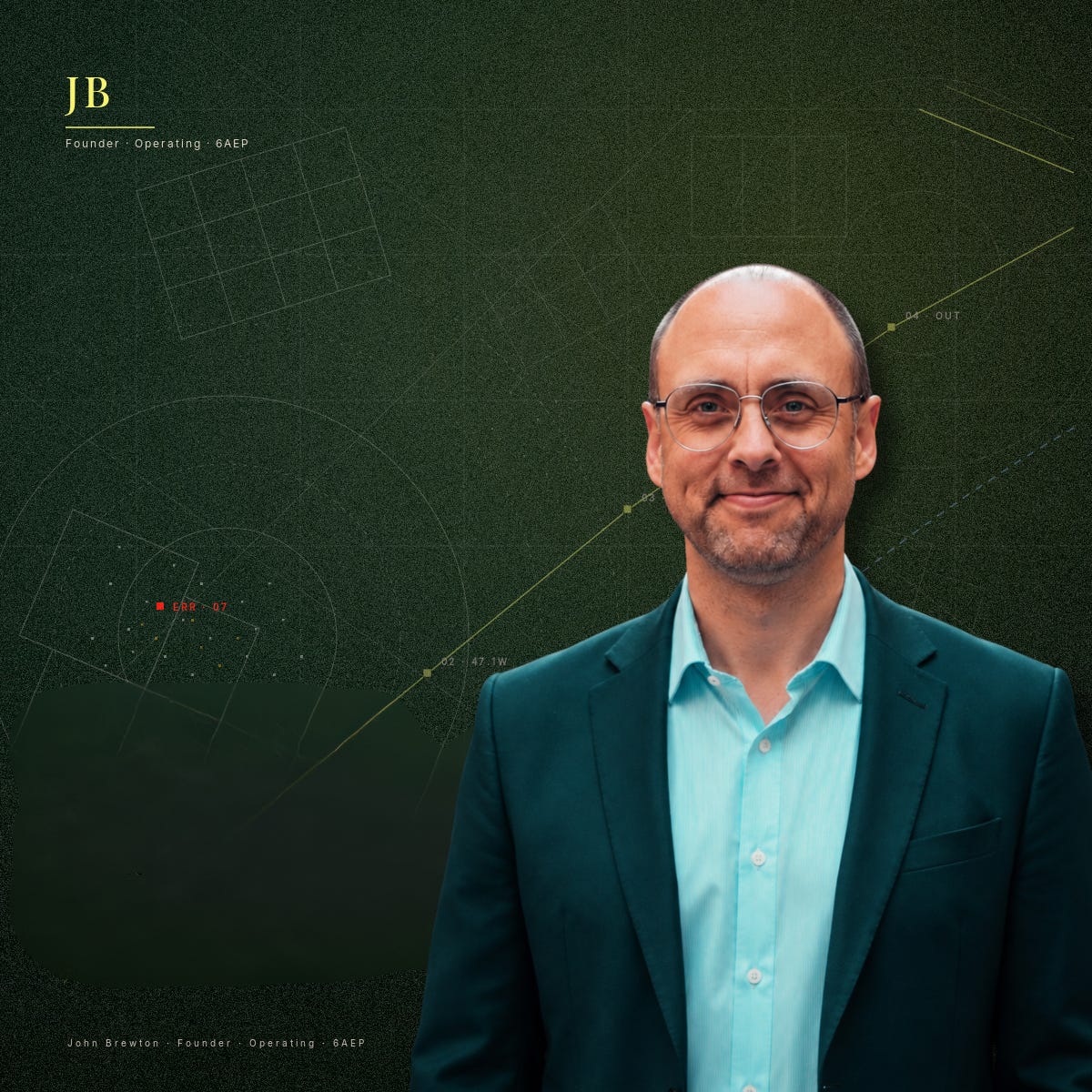
John Brewton documents the history and future of operating companies at Operating by John Brewton. He is a graduate of Harvard University and began his career as a PhD student in economics at the University of Chicago. Since selling his family’s B2B industrial distribution company in 2021, he has been helping business owners, founders, and investors optimize their operations.
If you already know how to solve an expensive problem, waiting until you have a big audience to decide what to sell can waste a lot of time. Build the offer while the audience is still small enough to talk to.
Well said, and so overlooked by many....
"But a 45-year-old operator with 22 years of experience does not begin at zero because she has 400 LinkedIn followers. She may have spent two decades solving problems companies were willing to pay millions of dollars to address.
Her audience might be small. But her economic value is not." - John Brewton -- The Problem with the Creator Economy