

How to Build an AI Operating Team in Grok Bot: The Field Manual
You Don’t Have a Software Problem. You Have a Database Problem.
AI Was Supposed to Kill Consulting. Instead It Has Started a Golden Age.
The Quiet Builders Are Coming. Great Companies Will Build Around Them.
Hello Operators!
Last week, the market put a price on the free answer, and the total exceeded half a trillion dollars.
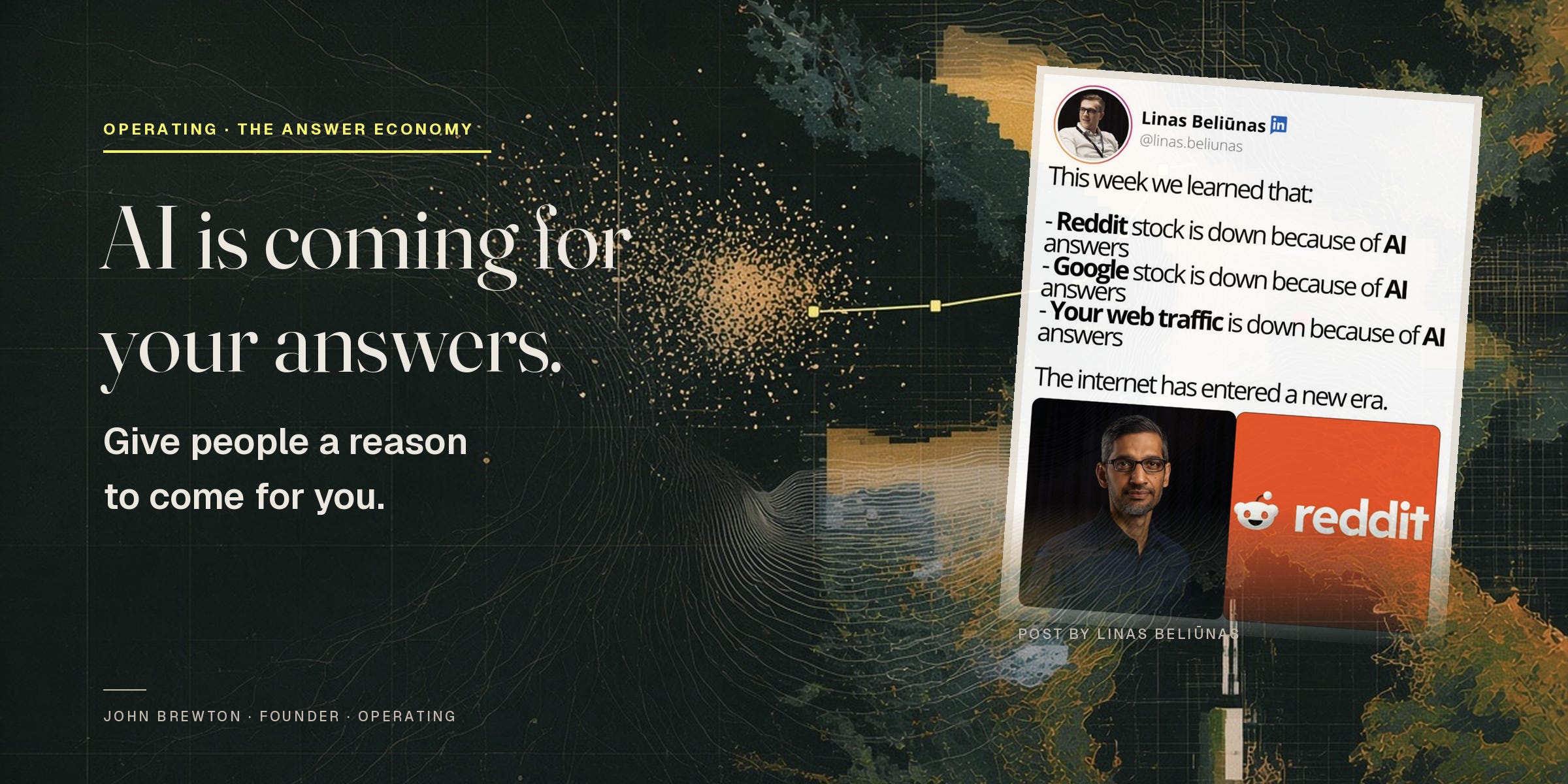
Linas Beliūnas summed it up better than I could in a post that’s been bouncing around my feed since Friday: Reddit stock is down because of AI answers. Google stock is down because of AI answers. Your web traffic is down because of AI answers. The internet has entered a new era. Social media has entered a new era.
I want to take that framing one step further, because the companies in those headlines are the headline version of a question every consultant, advisor and creator I work with needs to be asking.
What do people get from you that they can’t get from a prompt?
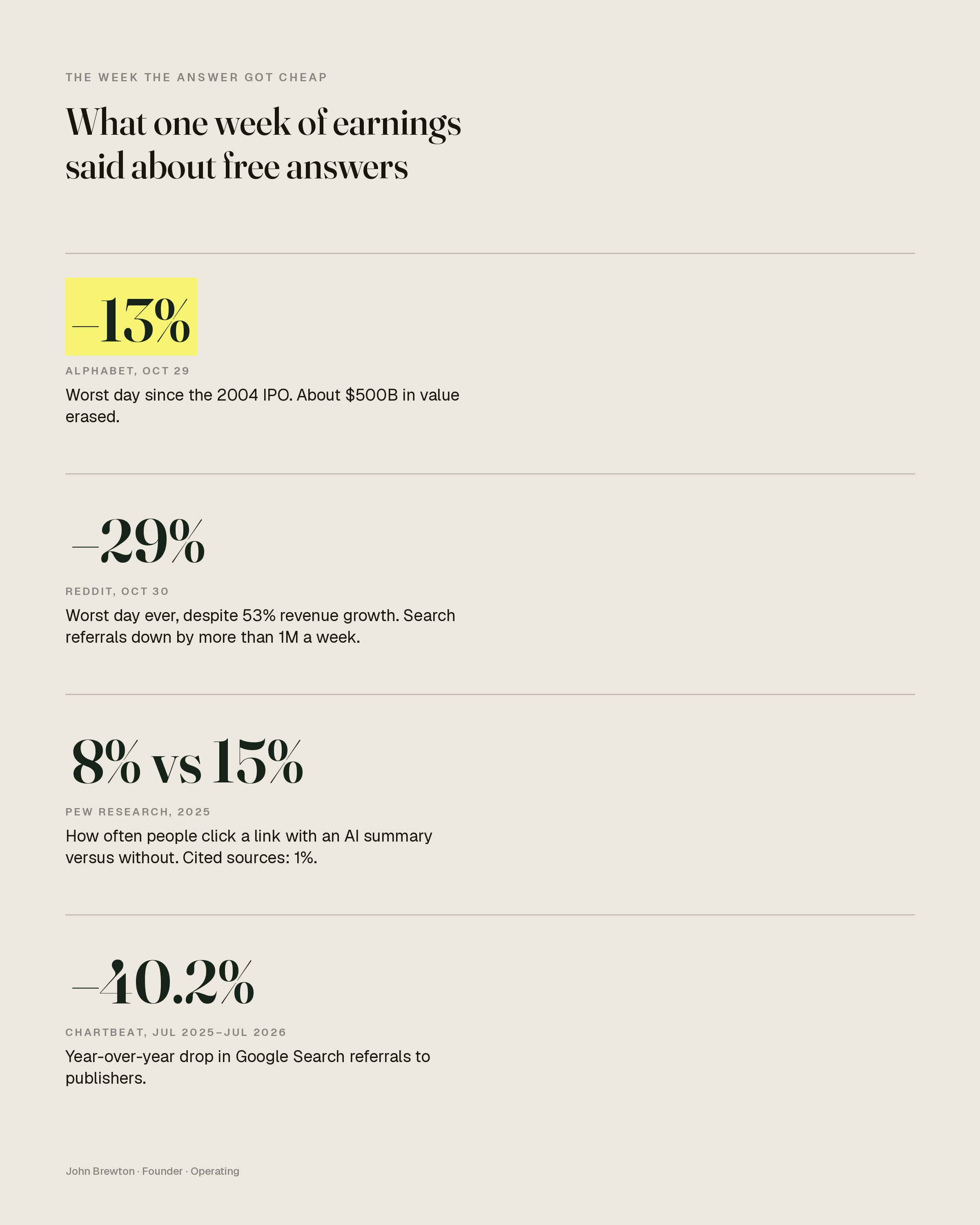
On Wednesday, October 28, Alphabet reported search revenue of $63.35 billion, up 12% but below analyst expectations for the second straight quarter. Philipp Schindler, Google’s chief business officer, told investors that AI Mode queries carry “lower monetization.” The next day the stock fell about 13%, its worst day since Google went public in 2004, and roughly $500 billion of market value went with it. Google also said query growth was the strongest in five years, which is the strange part. More people asked Google more questions, and Google made less from each answer.
Friday it was Reddit’s turn. The company beat on the quarter, with revenue up 53%, and then told investors its search referrals had dropped by more than a million a week through October. Steve Huffman warned that daily visitors could fall by a low double-digit percentage from about 130 million in the fourth quarter. The stock fell 29%, its worst day ever.
Reddit is the place people go for lived experience, and Google’s summaries now hand out that lived experience without the clicks.
Your Traffic Was The Canary
None of this surprised the people who run websites for a living.
Pew Research tracked 900 U.S. adults and their actual Google searches. When an AI summary appeared, people clicked a traditional link on 8% of visits, compared with 15% when there was no summary. They clicked a source cited inside the summary on 1% of visits. Chartbeat, which measures traffic across thousands of publisher sites, found Google Search referrals down 40.2% from July 2025 to July 2026, nearly double the decline it measured the year before. Over two years, small publishers lost 60% of their search traffic.
Chartbeat’s own read is the line I’d underline for every content business: “generic, easily-summarized content is the most exposed.” If your work can be summarized without losing anything, it will be, and nobody will click through to thank you.
Explanations Are Now A Commodity
If you sell content, consulting, advisory or professional services, here’s what is at risk:
An explanation.
A summary.
A framework.
A polished presentation of widely available ideas.
All of those are getting cheaper to produce every month, and I say that as someone whose agents now do a lot of my research and packaging. But I’m not complaining. I’m building on it.
What stays hard to reproduce is the perspective you earned by doing the work. The pattern you recognize because you’ve lived through it. The question you ask because you once asked the wrong one and paid for it. The recommendation you make because you know what implementation will cost the team that has to carry it out.
The answer is getting cheaper, and the judgment behind it is getting more valuable, and those two prices are moving in opposite directions.
Why I Subscribe To People
I don’t subscribe to someone because they can explain what everyone else can explain. I subscribe because I want to know what this specific person makes of it.
Their analysis surprises me. Their stories hold my attention. Their judgment helps me see a decision differently, and their voice makes me want to keep reading after I’ve gotten the point.
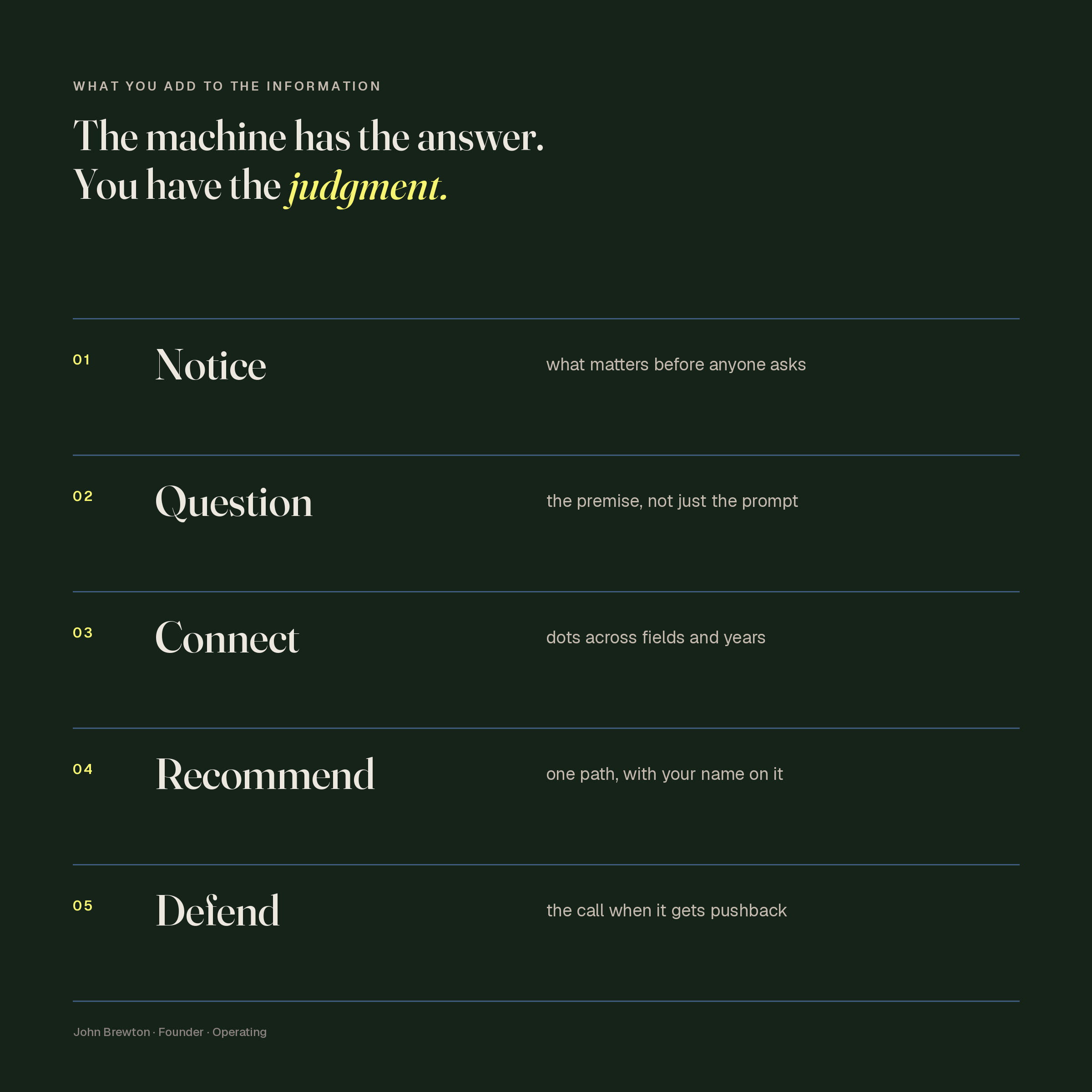
Education still matters. Increasingly, though, the value sits in what you add to the information: what you notice, what you question, what you connect, what you recommend and, most of all, what you’re willing to defend when someone pushes back.
Look again at where Chartbeat says publisher traffic is holding up. Direct visits, internal clicks, and links shared privately in texts and DMs all grew as a share of pageviews while search shrank. People still show up by name for the sources they trust. They just stopped wandering in by accident.
The Same Thing Is Happening Inside Companies
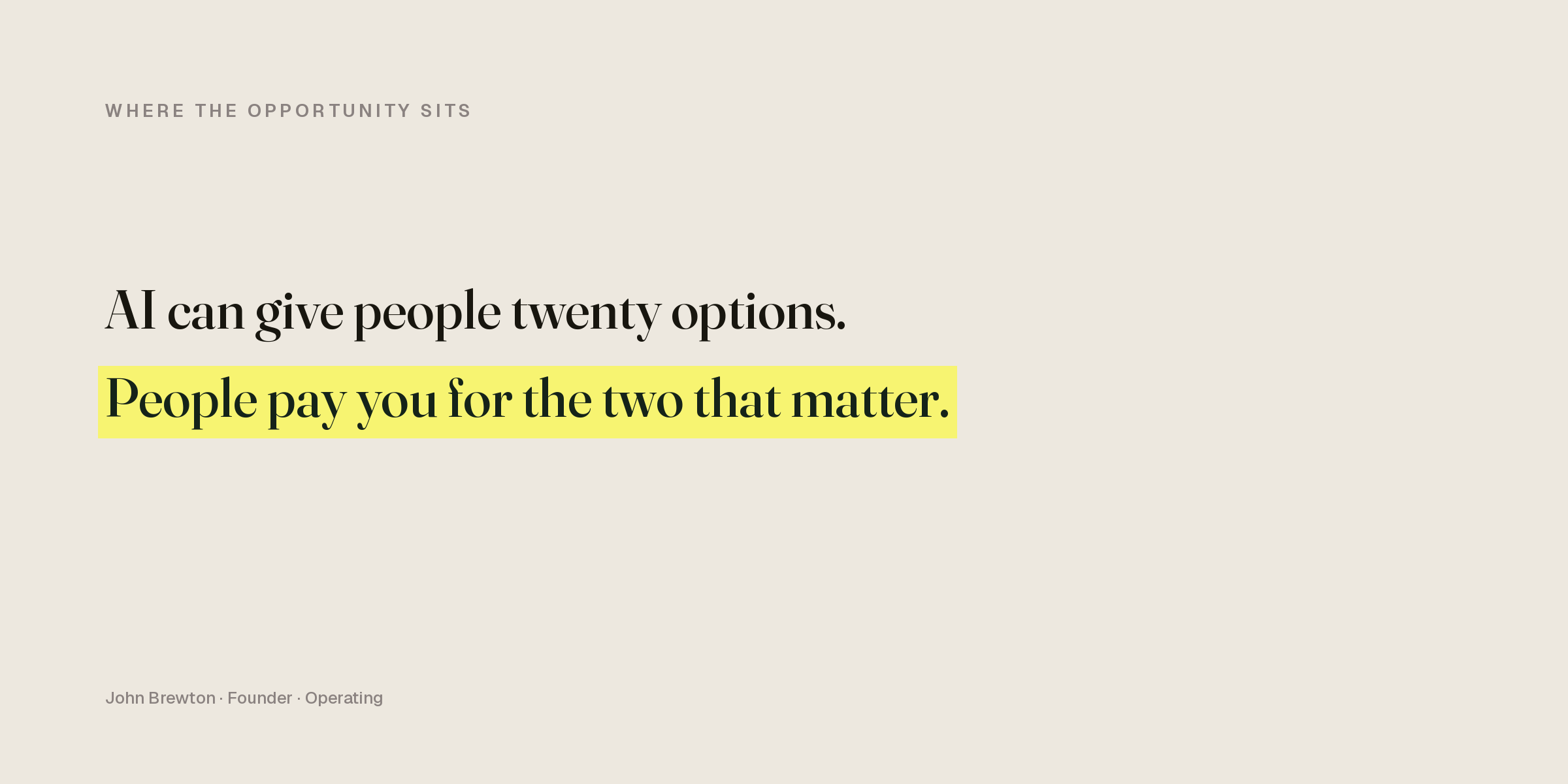
A CEO can ask AI for twenty ways to improve margins this afternoon, and the list will be pretty good.
The CEO can’t get from the list which two deserve attention, which assumptions need testing before anyone spends a dollar, or how to get a tired organization to actually act. I see this with clients every week. The data is rarely the problem. By the time it reaches the leadership team, it’s stale, or it was never true to begin with, and someone has to know which number to trust and own what happens next.
That takes context, judgment, trust, and responsibility for the outcome. An AI can hand you options all day, but it can’t be accountable for the one you pick.
This is what I mean when I say companies are becoming tech stacks. Software is absorbing the research, drafting, and analysis. What’s left for the people is the judgment that points the stack somewhere.
Let Them Experience Your Judgment First
So your content has a new job. It should let people experience your judgment before they ever hire you.
Show us why the obvious answer might fail.
Explain the tradeoff everyone skipped.
Tell us what changed your mind.
Make a difficult idea clear and compelling, even entertaining, and give us something worth thinking about after we close the app.
That is how you build a market of one. Your experience shapes your perspective, your perspective shapes your work, and your work gives people a reason to look you up by name instead of by keyword. Reddit is betting on the same thing. Its answer to losing search traffic is to push people to log in and come back on purpose.
When the search engine stops sending people, your name has to do the sending.
Where The Opportunity Sits
Here’s the opportunity I see for creators, consultants, and operators. We are all becoming companies, and AI lets one person research, build, and deliver at a scale that used to need a team.
Your judgment is what gives it direction. When everyone can publish an answer, people go looking for whose thinking they want in the room, and you want that to be an easy call.
If you’re a consultant, advisor, or creator working through what this means for your own offer, I’d love to talk with you.
- j -
How to Build an AI Operating Team in Grok Bot: The Field Manual
You Don’t Have a Software Problem. You Have a Database Problem.
AI Was Supposed to Kill Consulting. Instead It Has Started a Golden Age.
The Quiet Builders Are Coming. Great Companies Will Build Around Them.

John Brewton documents the history and future of operating companies at Operating by John Brewton. He is a graduate of Harvard University and began his career as a PhD student in economics at the University of Chicago. Since selling his family’s B2B industrial distribution company in 2021, he has been helping business owners, founders, and investors optimize their operations.
Sources
Linas Beliūnas LinkedIn post: “This week we learned that: Reddit stock is down because of AI answers; Google stock is down because of AI answers; Your web traffic is down because of AI answers. The internet has entered a new era.”
CNBC, “Alphabet tanks nearly 13% for worst day ever losing $500 billion value,” Oct 29, 2026: https://www.cnbc.com/2026/10/29/alphabet-google-microsoft-msft-shares-today-earnings.html
CNBC, “Alphabet earnings miss first sign AI is taking a bite out of search,” Oct 29, 2026: https://www.cnbc.com/2026/10/29/alphabet-google-search-ai-earnings.html
Financial Post/Bloomberg, “Alphabet erases record US$500 billion as AI eats into sales” (Schindler “lower monetization”): https://financialpost.com/investing/alphabet-erases-us500-billion-ai-eats-into-sales
BBC, “Google value plunges by $500bn as its own AI search hits ad sales”: https://www.bbc.com/news/articles/cm9qzdqpxy48o
CNBC, “Reddit plunges 29% after issuing weak outlook for its worst day ever,” Oct 30, 2026: https://www.cnbc.com/2026/10/30/reddit-stock-q3-earnings.html
Reuters via Investing.com, “Reddit shares plunge as Google’s AI search squeezes traffic”: https://www.investing.com/news/stock-market-news/reddit-pinterest-shares-tumble-on-weak-user-and-revenue-growth-4987225
Reddit Q3 2026 earnings call transcript (53% revenue growth, >1M weekly referral drop, ~130M DAUq): https://earningscall.biz/e/nyse/s/rddt/y/2026/q/q3
Pew Research Center, “Google users are less likely to click on links when an AI summary appears,” Jul 22, 2025: https://www.pewresearch.org/short-reads/2025/07/22/google-users-are-less-likely-to-click-on-links-when-an-ai-summary-appears-in-the-results/
Search Engine Journal on Chartbeat 2026 Publisher Playbook (-40.2% Google Search, “generic, easily-summarized content is the most exposed,” direct/dark social/internal share growth): https://www.searchenginejournal.com/google-search-decline-publishers-chartbeat/590681/
Axios, “Small publishers hit hardest by search traffic declines” (Chartbeat, -60% small publishers over two years), Mar 17, 2026: https://www.axios.com/2026/03/17/chartbeat-search-traffic-ai-chatbots