

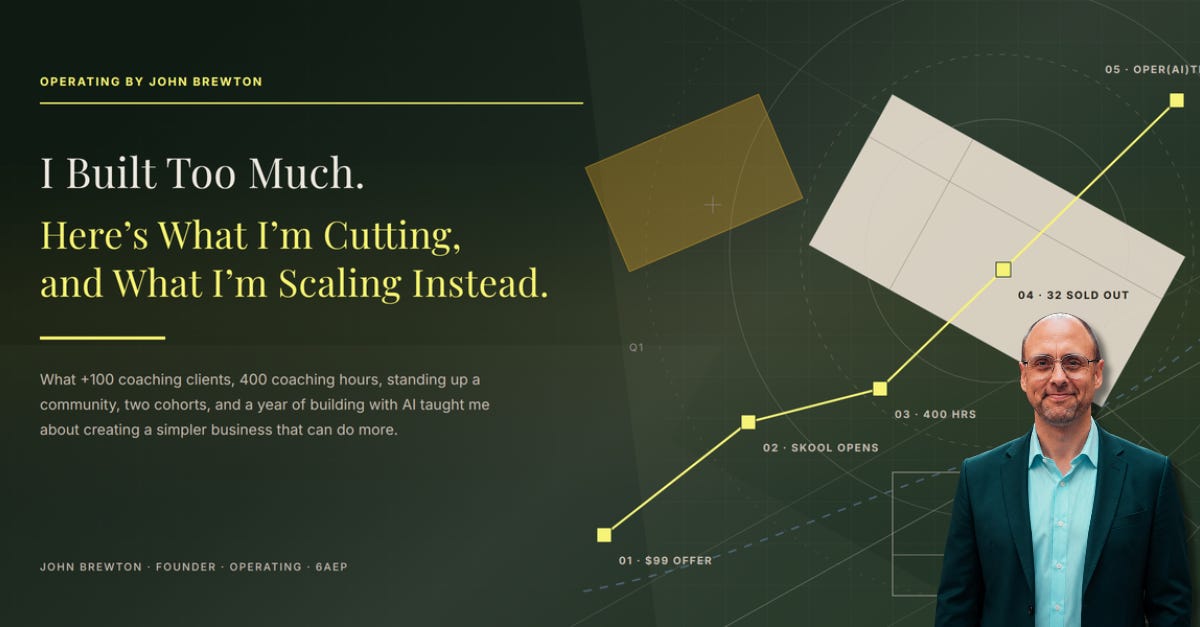
This year, I ran a $99 offer: four coaching sessions for $99.
More than 100 people took me up on it in twelve days.
I ended up delivering more than 400 hours of coaching.
During those same months, this newsletter became a Substack bestseller. I launched two course cohorts. I opened a community on Skool. I started building my own software to help me run my business. And underneath all of it, I maintained a full-time commitment to my consulting work.
None of these endeavors failed.
That is what makes the next part important.
I simply built across too many surfaces:
Too many places where the business needed me to show up.
Too many products.
Too many platforms.
Too many workflows.
Too many pieces of software.
Too many things that were each perfectly reasonable on their own.
That is the dangerous thing about complexity.
You rarely wake up one morning and decide to make your business harder to run.
You add one good idea.
Then another.
Then another.
Eventually, the work of operating all the good ideas becomes the bad idea.
So going into the next 12 months, I am concentrating this side of the business around three things:
Teach many people at once.
Build working tools that people can operate without me.
Publish useful work that compounds and people are willing to pay to receive.
Everything else has to justify why it deserves another piece of my time.
And when I stepped back from all of those decisions, I realized something else.
I had spent the entire year using one framework.
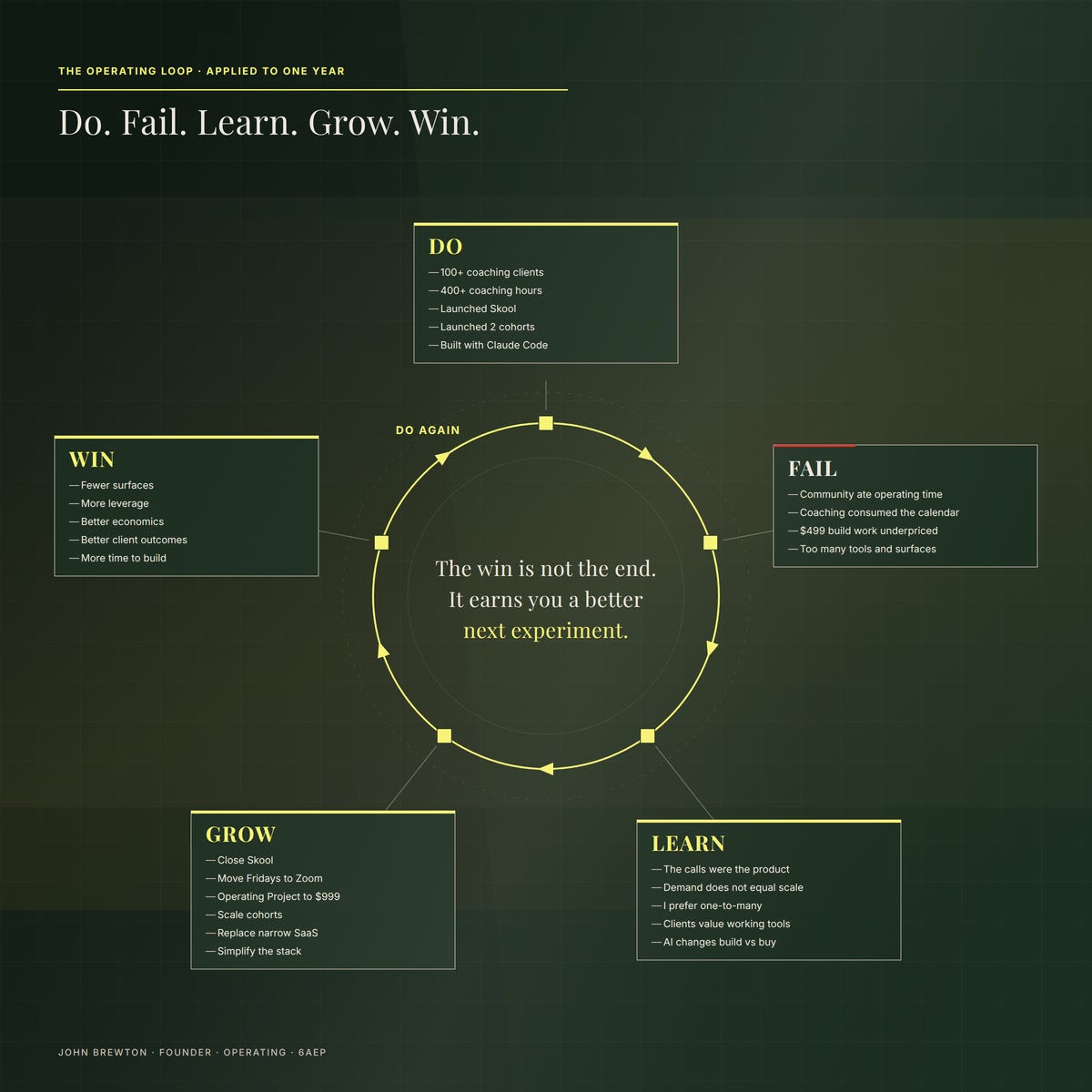
Do. Fail. Learn. Grow. Win.
I wrote the full Do. Fail. Learn. Grow. Win. framework here.

The short version is:
Do: Put something real into the world.
Fail: Pay attention to where reality disagrees with your plan.
Learn: Figure out why.
Grow: Change the next attempt.
Win: Keep what works and use it to create the next opportunity.
Then go back to the start and Do More.
That is basically the story of my year.
And I think it explains much more about where this business is going than any five-year plan I could have written in January. It is also my sincere hope that my experience, the challenges I have faced, and the decisions I’ve made can help you in building your newsletter or solopreneur business.
How I Built a $200,000 Newsletter Business From a Substack Nobody Was Reading
The Five Moves That Turned My Substack Into a $200,000 Business
The Operating Project: Most Coaching Ends With Notes. This Ends With a Machine.
How to Produce World-Class Research with Perplexity Computer & Claude -> Fable 5
1. Do
I did a lot this year.
Probably too much.
But I am increasingly convinced that the “too much” part was necessary to learn what I know now.
I launched the $99 coaching offer.
More than 100 people bought it in twelve days.
I spent more than 400 hours sitting directly with business owners, founders, creators, and operators.
I opened the Skool community.
I started the Friday Q&A calls.
I built the Compound Content Studio, where I taught people how to scale their content operations with Claude. The idea came from my now business partner, Wessal Khader, and man am I happy I said ‘Yes’ to her idea.
We launched the Oper(AI)te Summer of AI Fluency immediately afterward.
I started building internal software with Claude Code.
I experimented with AI agents.
I changed workflows.
I added tools.
I removed tools.
I tested different ways of teaching, consulting, coaching, building, and publishing.
There was no shortage of doing.
And that matters because almost everything I now understand about this business came after I put something in front of a customer.
That is very close to the argument Steve Blank made in his classic Harvard Business Review piece on the Lean Startup.
A new business model is not something you reason your way to perfectly in a conference room. It is a collection of assumptions.
So you put those assumptions into the world.
You watch what happens.
You change them.
Then you try again.
I could have spent six months designing the perfect coaching offer. I still would not have known what 100 actual clients were about to teach me.
I could have spent three months building the curriculum for Compound Content Studio. Instead, we designed it in three days, sold it for one week, and filled all 32 seats.
I could have spent months planning the perfect community. Instead, I built one and discovered that the part people really valued was the Friday call.
Reality is an excellent editor.
You just have to ship something before it can edit you.
There is also a much bigger economic change making this kind of experimentation possible for more people.
The U.S. Census Bureau counted more than 30 million American businesses with no paid employees in 2023. Together, those businesses generated nearly $1.8 trillion in revenue.
The creator economy has added another layer.
An IAB study led by Harvard Business School Professor Emeritus John Deighton estimates that the equivalent of more than 1.5 million Americans now work full-time as digital creators, nearly eight times the 2020 number.
And AI appears to be lowering the barrier to starting even further.
A 2026 study of more than 160,000 Product Hunt launches found a jump in entrepreneurial entry after ChatGPT arrived, disproportionately driven by solo founders.
The same study found an important limit:
Teams still dominated the highest-performing products.
That feels about right.
AI makes it much easier for one person to attempt things that once required a team.
It has not repealed the laws of time.
And time was the problem I eventually ran into.
I did not need more things I could do.
I needed fewer things I had to operate.
If you’re enjoying this article, you’ll probably love this article!
Quiet Quitting or Quiet Building? Our Changing Relationship With Professional Ambition

2. Fail
This is where I want to be careful with the word fail.
My community did not fail because nobody joined.
My coaching offer did not fail because nobody wanted it.
The Operating Project did not fail because nobody bought it.
In some ways, those are harder failures to notice.
Demand can hide a bad operating model.
You can have customers and still have the wrong business.
You can have engagement and still have the wrong product.
You can have revenue and still have terrible economics.
You can be growing and still be building something you do not actually want to operate.
That was the kind of failure I had this year.
The community worked. The container did not.
The Skool community is shutting down.
The Friday calls are staying.
I am moving those to Zoom.
Running the community cost me roughly three to four hours every week.
There was platform-specific content.
Engagement.
Moderation.
Administration.
And all the little things that come with maintaining another place where people expect you to show up.
When I looked at what members actually valued most, the answer was obvious.
The Friday calls.
Which, inconveniently, were the reason I built the community in the first place. Everything around them had become a second publication I had accidentally agreed to run.
Building a community is not a bad idea.
It just turned out not to be my good idea.
Bain has studied a much larger version of this problem for years.
In Killing Complexity Before Complexity Kills Growth, the firm describes complexity as a silent killer of growth.
Companies add products.
Processes.
Business units.
Layers.
Systems.
Each addition can make sense.
Eventually, more and more of the organization gets consumed by managing the organization itself.
I somehow recreated a tiny solopreneur version of the same problem.
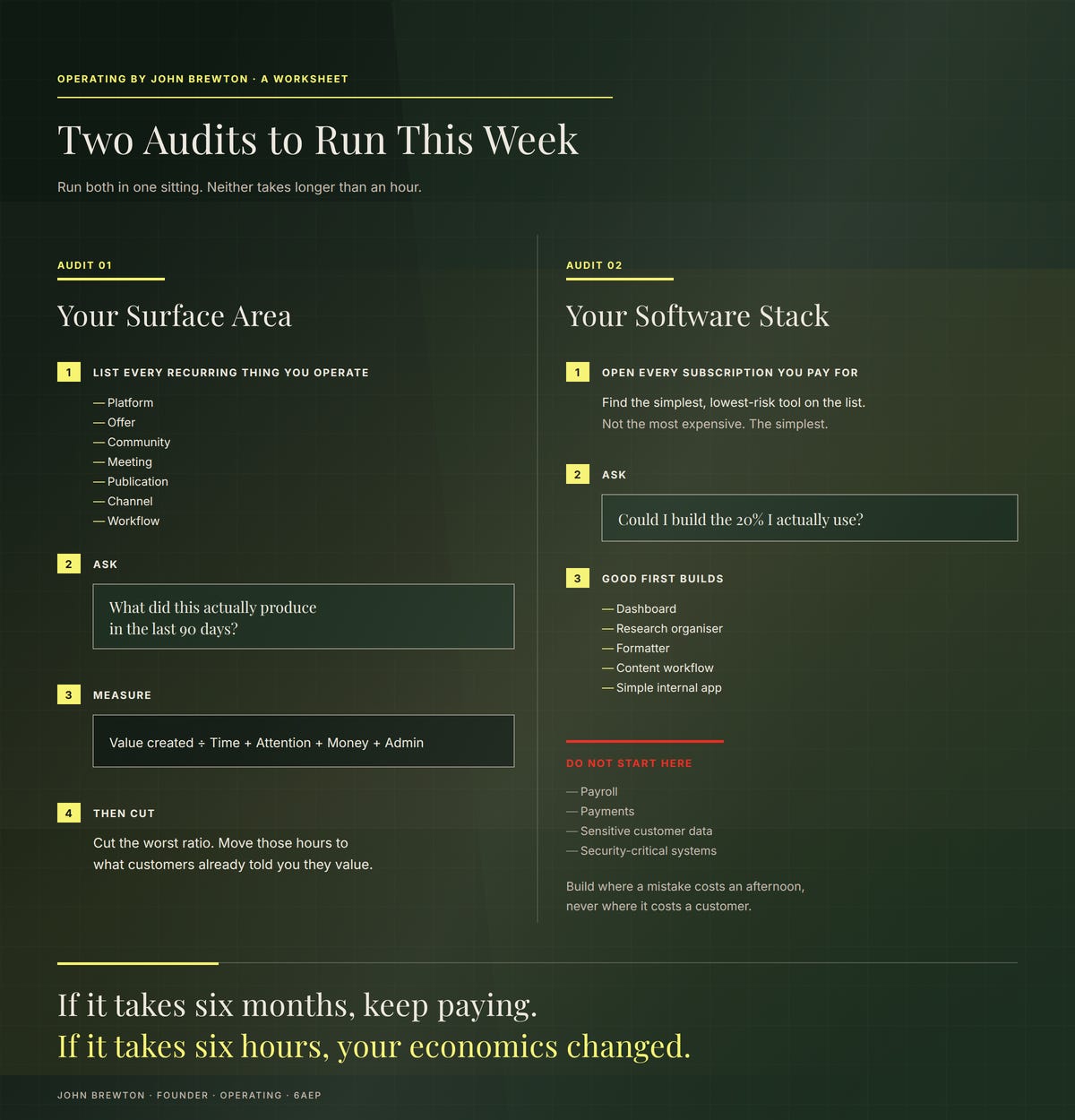
I had a surface-area problem.
The lesson was not:Communities do not work.
The lesson was: The calls were the product. The community was the container.
So I am keeping the product.
And deleting the container.
Coaching worked. My calendar did not.
Coaching was probably the most enjoyable work I did this year.
More than 100 people.
More than 400 hours.
I learned more about how small companies actually operate than I would have learned from almost any dataset.
I am not walking away from coaching.
I am walking away from trying to build a large coaching practice.
One-to-one services scale almost perfectly with one thing I do not have more of:
My calendar.
That is an old professional-services problem.
Harvard Business Review has written about “putting products into services”: turning the repeatable parts of expertise into systems, technology, or products while keeping humans involved where judgment really matters.
That is increasingly what I want.
I do not want someone to need another hour with me every time they want to use something I know.
I want some of the knowledge to remain behind after the call ends.
That leads directly to the Operating Project.

We pick one problem in your business.
We develop the strategy.
Then we build the actual piece of technology you need to run it.
Usually that takes around four sessions, although some projects go longer.
The important difference is the output.
You do not leave with a plan.
You leave with a tool.
That distinction keeps getting more important to me.
A strategy document creates work.
A functioning system absorbs work.
A checklist helps someone remember what to do.
A tool can actually do some of it.
Career coach Julia Starr ran into a similar constraint after years of selling her time.
In a Business Insider account of how she used AI to extend her coaching methodology, she describes moving from coaching and prompts toward building an actual application around her framework.
That is where I think a lot of expertise businesses are going.
The expert does not disappear.
The expertise becomes more transferable.
3. Learn
This is the most important part of the framework.
Failure itself has almost no value.
People like to say:
“I learned from failure.”
Sometimes.
But plenty of people fail the same way for 15 years.
The value comes from identifying why something missed and changing what you do next.
That is Learn.
And by the end of this year, I had a few lessons I trust.
If building this kind of business and capability is especially appealing to you, and you want to learn everything you can in the year ahead, become an Operating Founder and join my 52-week-per-year Friday live Q&A sessions with The Operating Founder Community. We are a +200-strong group of Operators and Builders choosing a new vision for our futures.
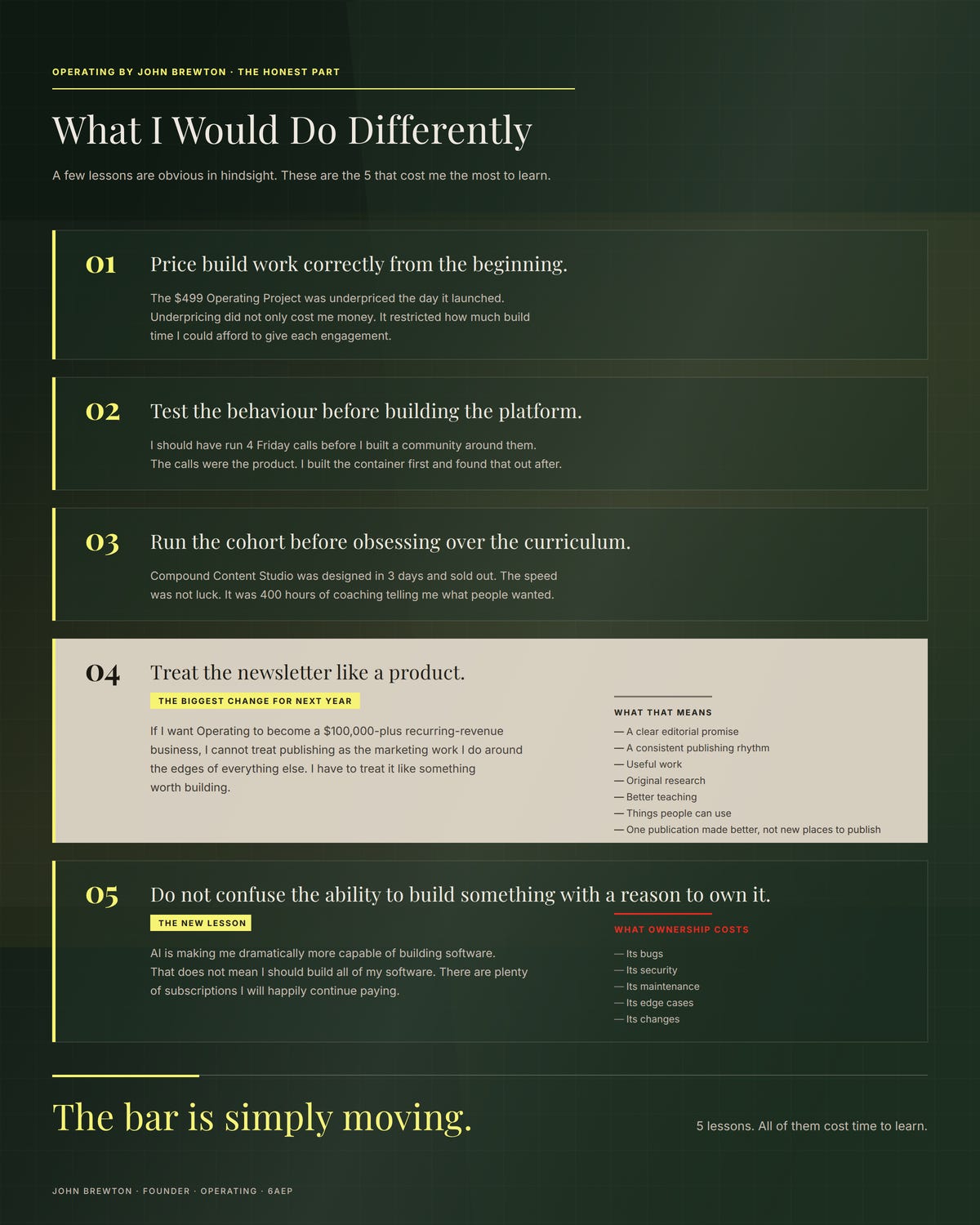
Lesson 1: The thing customers value may not be the thing you built around it.
The Friday calls were the product.
Skool was the container.
That sounds incredibly obvious now.
It was not obvious when I was building it.
This is why testing behavior before building infrastructure matters.
I should have run four Friday Zoom calls first.
If people loved them, I could decide afterward whether they needed a community around them.
Instead, I built the container and then discovered which part people actually wanted.
Next time, I test the behavior first.
Lesson 2: Demand does not automatically mean scale.
I had plenty of coaching demand.
That was not the problem.
The problem was that every new client meant more of my calendar.
That is fine if your ambition is to build a great coaching practice.
Mine is not.
I want to teach.
I want to work directly with people.
I want to help solve real problems.
I just do not want every additional dollar of revenue to require another hour from me.
That is why the cohorts matter.
And it is why the newsletter matters even more now.
Lesson 3: I am better at one-to-many than one-to-one.
The first cohort was Compound Content Studio, which I built with a business partner I met on Substack. It was her idea. We taught people how to create social content with Claude.
We designed it in three days.
Sold it for one week.
Closed the cohort at 32 people.
It sold out.
Immediately afterward, we launched Oper(AI)te Summer of AI Fluency.
That program teaches people how to build teams of AI agents that perform real work inside their businesses:
A branding, visual, and voice team that creates proposals, decks, and social content
A research team that conducts market and company research at institutional quality
An operations team that absorbs administrative work
One custom agent team for each member, designed around the work their specific business needs done
The cohort model itself is not new.
Andreessen Horowitz wrote about the rise of cohort-based courses years ago: live instruction, deadlines, peers, accountability, and interaction without requiring the instructor to teach every student separately.
Creator businesses have arrived at similar models.
Former Big Tech program manager Jean Kang described to Business Insider how she moved from individual coaching into a six-week group cohort while building her independent education business.
Justin Welsh’s self-reported account of building a solo business past $10 million in cumulative revenue shows a business evolving across consulting, products, subscriptions, sponsorships, and community rather than relying forever on one-to-one work.
The point is not that cohorts are magic.
They are simply a much better match for how I want to work.
I want interaction.
I want questions.
I want to see people build.
I want to watch someone change what they are doing while we are working together.
I just do not need to explain the same thing 100 times in 100 separate Zoom windows.
Lesson 4: Publishing may be the highest-leverage teaching I do.
This one took me longer to see.
Operating already generates about $17,000 in annual recurring revenue from paid subscriptions.
I have tended to think about Substack in two ways:
As a publishing business.
And as the top of the funnel for everything else.
Someone reads an article.
Maybe they eventually join a cohort.
Hire me.
Buy an Operating Project.
Attend a workshop.
That will all continue.
But I think I have been underestimating the publication itself.
A newsletter is one-to-many teaching too.
Maybe the purest form of it.
I can learn something once.
Write it once.
Teach it to thousands of people.
And unlike a call, the work does not disappear when the hour ends.
It becomes part of an archive.
Someone can discover it six months later.
Or two years later.
A useful article can keep teaching after I have moved on to the next one.
That is exactly the kind of leverage I am trying to create everywhere else in the business.
So the newsletter cannot just promote the work.
The newsletter needs to become more of the work.
Lesson 5: Attempts compound.
This may be the biggest one.
The speed at which we designed Compound Content Studio was not luck.
It was the 400 coaching hours.
By then, I had heard the problems.
Again.
And again.
And again.
I knew what people struggled with.
I knew which explanations landed.
I knew where they got stuck.
I knew what they were willing to pay to learn.
That made the next thing faster.
This is where I think people sometimes misunderstand experimentation.
The failed attempt is not wasted if it makes the next attempt smarter.
Pieter Levels may be one of the clearest creator examples.
His public list of projects contains plenty of recognizable winners: Photo AI, Remote OK, Nomads.com, Interior AI.
It also contains a very large graveyard.
That is the important part.
He built a lot.
Most did not become huge businesses.
A few worked extremely well.
The failures were not an embarrassing detour around the process.
They were the process.
That is also why I like the Do. Fail. Learn. Grow. Win. framework.
It gives failure a job.
Failure creates information.
Learning turns the information into a change.
Growth proves that you actually made the change.
Then you get another chance to win.
Lesson 6: The work should leave something behind.
This is probably the most important lesson for how I think about client work now.
I want the work to end in something the other person can operate without me.
Not just advice.
Not just a deck.
Not just a call recording.
Not just “here is what you should do.”
Something that helps do the thing.
A workflow.
An agent team.
A research system.
A dashboard.
An application.
A tool.
That is where what I learned from coaching intersects with what is happening in AI.
Because for the first time, building the tool is becoming cheap and fast enough that it can be part of the engagement.
And that changes what a consultant can sell.
4. Grow
Growth is where you prove you learned something.
You change the next attempt.
That is what the next 12 months are about.
Not adding more.
Changing the shape of what is already working.
What I am closing
Skool goes away.
The Friday call stays.
Those three to four hours a week move toward making one thing better instead of keeping an entire platform alive.
What I am changing
Large-scale one-to-one coaching goes away.
The Operating Project stays.
It moves from $499 to $999.
The engagement includes more build time.
And the deliverable becomes much clearer:
The output is a working tool, not a plan.
What I am scaling: cohorts
The cohorts worked.
So the plan for the next 12 months is one to two new cohorts per quarter, plus workshops in between.
That becomes one of the centers of this side of the business.
But it is not the only one.
What I am scaling even harder: Operating
The other major bet is this newsletter.
Today, paid subscriptions to Operating generate about $17,000 in annual recurring revenue.
That is meaningful.
But I think it can become much more meaningful.
My goal over the next 12 months is to turn that into a $100,000-plus recurring-revenue business.
That is roughly a sixfold increase.
Which means I cannot get there by simply asking more people to pay for the same thing.
The product has to get better.
A lot better.
So I want to triple down on the thing I discovered I enjoy most this year:
Teaching:
My target is four to five articles every week.
Not four or five essays summarizing AI news.
There are already plenty of places to find AI news.
I want Operating to help people do something.
I want to show you what I am building.
How I built it.
Why I built it.
Where it failed.
What I changed.
What happened when a better model arrived.
What manual workflow became an agent.
What prompt became a Skill.
What piece of software I stopped buying because I built the part I actually needed.
What I learned from solving a real operating problem inside my consulting work.
And what you can take from all of it and use yourself.
I want Operating to become a running field guide for building a more capable business with AI.
There are three things I want to teach here.
1. Build with the models
AI is moving too quickly for this publication to become a static library of prompt tricks.
I want to teach against the frontier as it moves.
When Claude gets better at software development, I want to show you what suddenly becomes buildable.
When ChatGPT gets better at multi-step work, I want to test it against something real.
When agents become more reliable, I want to put them inside actual workflows and show you where they work and where they break.
When a model crosses a capability threshold, I want to go back to something that failed six months ago and try again.
The useful question is not:
What model launched this week?
It is:
What can we build now that we could not build before?
That is the question I want Operating to answer again and again.
2. Build a better business
The second source of material is my consulting work.
I get to sit inside companies and see how work actually happens.
The workaround someone created five years ago.
The spreadsheet everyone quietly depends on.
The process nobody has written down.
The piece of software everybody pays for but nobody enjoys using.
The meeting that creates six follow-up tasks nobody wants to do.
The handoff that only works because Susan remembers it every Thursday.
Increasingly, I can look at those problems and ask:
What would this look like if we rebuilt it for an AI-first company?
Some of those solutions will remain client-specific.
But many of the lessons will not.
I want to bring those lessons back here.
Not confidential client information.
The operating insight.
The pattern.
What failed.
What worked.
What somebody else can use.
That creates a loop I like a lot.
Consulting gives me real problems.
Building gives me real experiments.
Operating gives me a place to teach what I learn.
And the questions readers ask create the next problems worth solving.
3. Build something you own
The third subject may ultimately become the biggest.
I want to spend much more time studying how the best solopreneurs, newsletter writers, creators, and small internet businesses in the world actually operate.
Not just how they create content.
How they build businesses.
What they sell.
How they price.
Where recurring revenue comes from.
How they turn expertise into products.
How they move beyond one-to-one services.
How they build newsletters people pay to read.
How they create distribution they own.
How they use AI.
How small their teams are.
What they automate.
What they refuse to do.
What their technology stacks look like.
Where the margins come from.
And what we can learn from them.
Because I think there is a much bigger story happening underneath all of this.
For most of modern business history, if you were highly ambitious, one of the obvious paths toward creating financial security for yourself and your family was to build a career inside somebody else’s organization.
It looked like this:
Get promoted.
Manage more people.
Earn more.
Accumulate equity.
There is nothing wrong with that route.
It remains an excellent one.
But technology has opened another path.
A person with expertise, an audience, distribution, AI, and the ability to build products now has access to operating leverage that not long ago would have required employees, developers, designers, researchers, and meaningful capital.
That does not make building a one-person business easy.
It makes a different kind of business possible.
I want Operating to study that possibility seriously.
Who is actually making it work?
How are they doing it?
Which parts are real and which parts are internet mythology?
What do the best newsletter businesses understand about recurring revenue?
What do the best creators understand about distribution?
What do the best solopreneurs understand about focus?
And how do you turn those lessons into something exceptional that you own?
Something that creates income.
Something that gives you options.
Something that can create real financial security for you and your family.
That is a subject I can imagine exploring here for years.
The newsletter itself becomes part of the experiment
Appropriately, I am going to use my own newsletter to test the thesis.
Today:
About $17,000 in annual recurring subscription revenue.
The next milestone:
$100,000+.
That is not a small increase.
It means I need to make the paid product dramatically more valuable.
More useful articles.
More original research.
More builds.
More templates.
More frameworks.
More case studies.
More things readers can actually take and use.
But there is an important constraint.
I do not want to reach $100,000 by creating another giant surface-area problem.
I do not want five newsletters.
Seven communities.
Three membership tiers.
A Discord server.
A course vault with 400 videos nobody finishes.
The experiment is whether I can grow the revenue and value of one publication by making the publication itself dramatically better.
That is very consistent with everything this year taught me.
Do not automatically add another surface because you want more growth.
Make the best surface more valuable.
That is what I want to do with Operating.
The three engines
The shape of the business is becoming much clearer.
There are three engines.
1. Paid publishing
Operating.
Teach at scale.
Build an archive.
Own the relationship with the audience.
Create recurring revenue.
Turn the things I am already learning into something thousands of people can use.
2. One-to-many education
Cohorts.
Workshops.
Friday calls.
Teach people live.
Help them build.
Answer questions.
Watch where they get stuck.
Then feed those lessons back into the publication and the next cohort.
3. Tool-building
Operating Projects.
Consulting builds.
Internal applications.
Agent teams.
Take what I know and turn more of it into something another person can actually operate.
These three things feed one another.
The consulting work gives me problems worth solving.
The builds give me things worth teaching.
The cohorts tell me where people struggle.
The newsletter turns those lessons into reusable intellectual property.
The audience creates more questions.
Those questions create new experiments.
And the experiments give me more to write about.
That is the flywheel I want.
Not more surfaces.
More value moving through fewer surfaces.
The stack
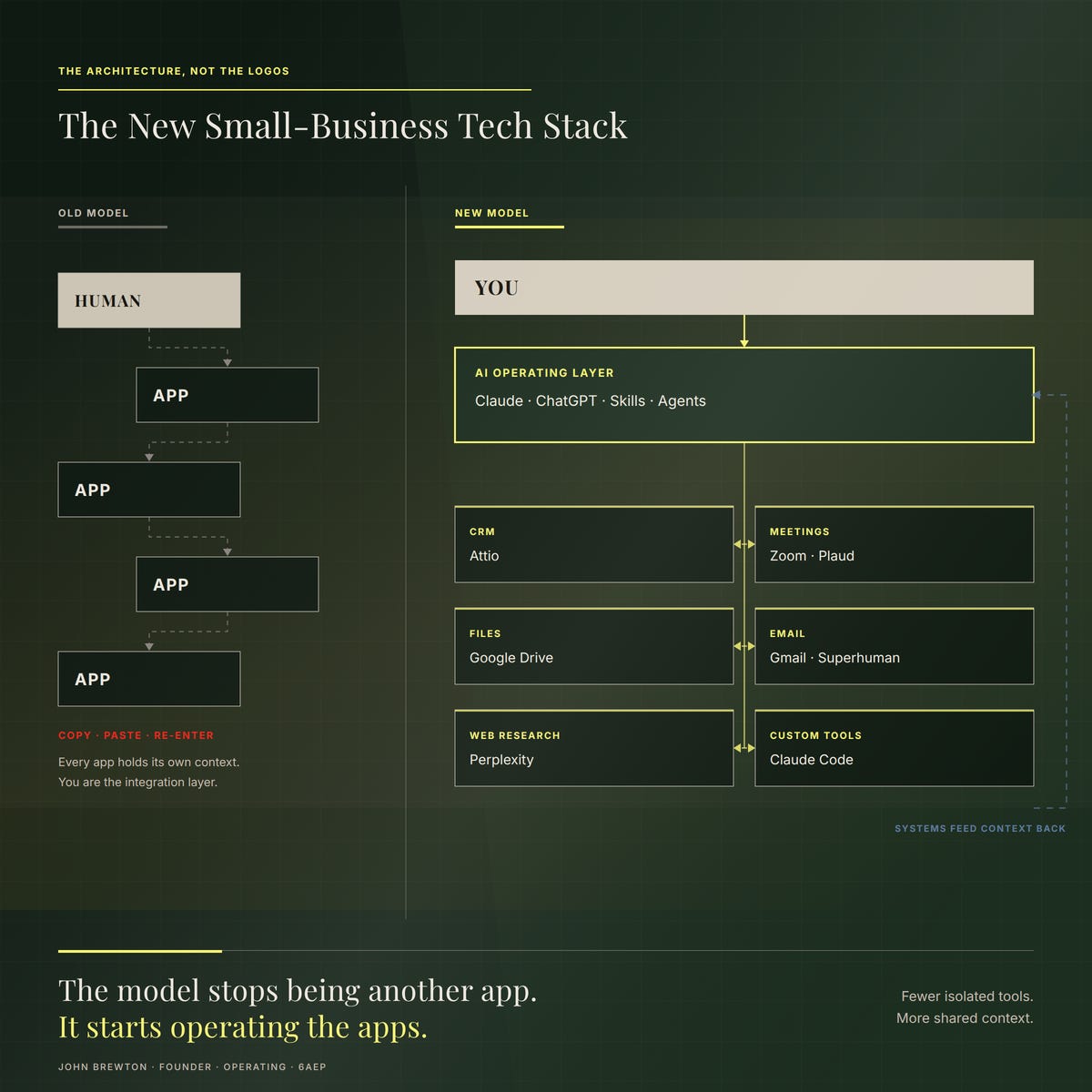
The technology underneath all of this is changing too.
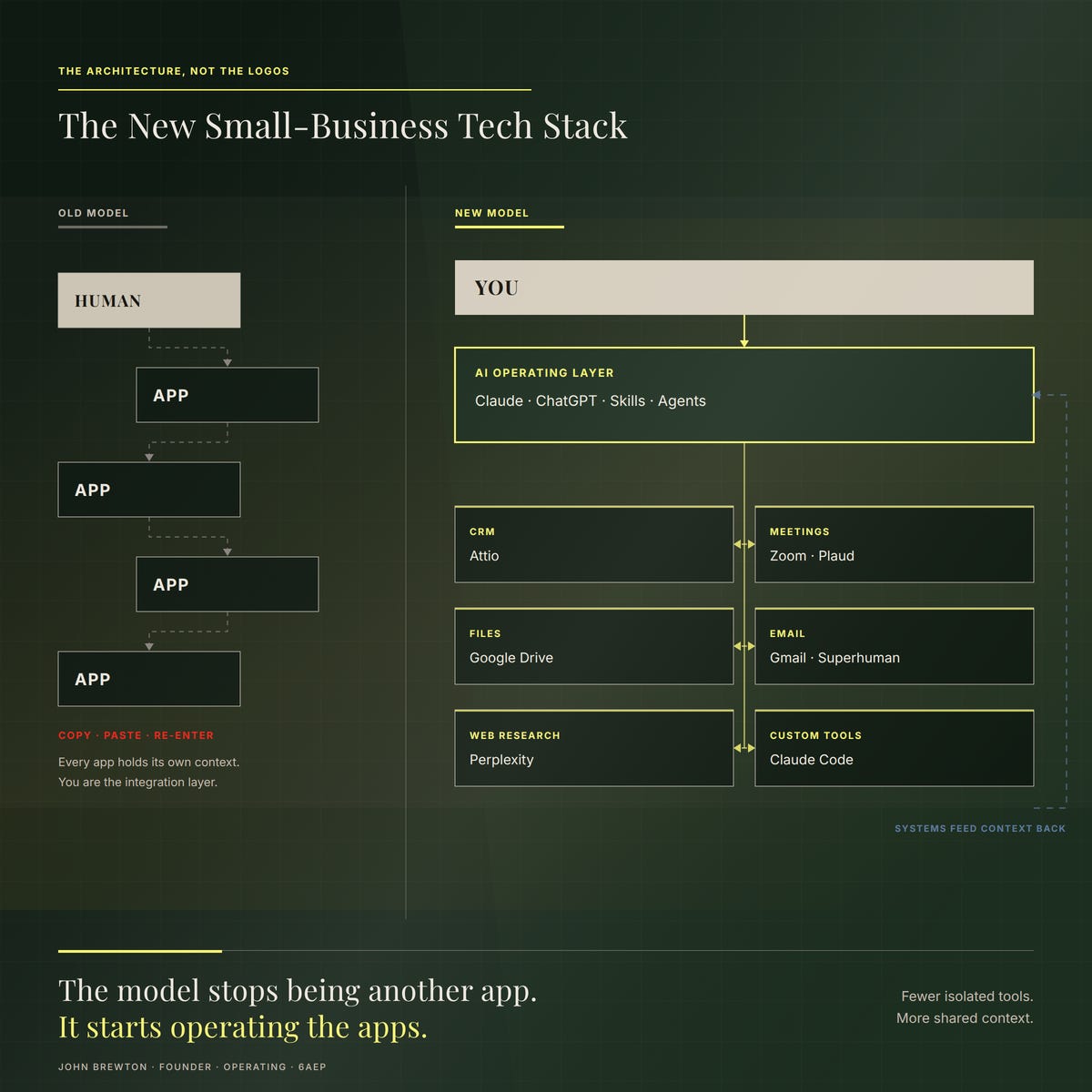
Here is what actually runs the business now.
Claude is the operating layer.
Writing, research, analysis, and most of the agent teams start there.
Claude Skills are how Claude learns the business.
Brand systems.
Voice profiles.
Meeting workflows.
Inbox workflows.
Research standards.
Each one encodes a way of working so I do not have to teach the model the business from zero every time.
Anthropic’s explanation of Agent Skills describes them as reusable instructions, resources, and code that give an agent specialized ways of performing recurring work.
That is exactly how I think about them.
I do not want to prompt better forever.
I want the standard built into the system.
Claude Cowork is where more of that work runs against my files and connected systems.
Anthropic’s Claude for Small Business points directly toward this model: agents, skills, connected information, and workflows built around functions such as operations, sales, marketing, finance, and customer service.
Claude Code is where I build.
Internal applications.
Workflows.
Small pieces of software.
Tools for my own company.
Tools inside client engagements.
ChatGPT Work is the second operating environment.
I want two frontier AI systems.
They have different strengths.
Different weaknesses.
Different failure modes.
Anything important gets a second opinion.
OpenAI’s current direction with ChatGPT Work points in the same direction as Claude: persistent projects, reference files, reusable templates, tools, and multi-step work rather than a blank chat box that starts from zero every time.
Perplexity Comet and Computer handles advanced web research.
Perplexity describes Comet as an AI-powered browser capable of researching, navigating, summarizing, and working across the web.
Zoom runs every call.
More interestingly, it is starting to become part of the connective tissue between systems.
Zoom’s MCP integration with Claude can expose meeting intelligence to Claude Cowork and Claude Code.
That matters to me much more than having another AI meeting summary.
A meeting should not disappear inside the meeting app.
It should become operating context.
Plaud captures meeting transcripts.
Attio is the CRM.
And increasingly, Attio is the spine of the operation.
It holds client context.
Transcripts.
Progress.
Relationships.
And through Attio’s MCP support, AI systems such as Claude and ChatGPT can work directly against that CRM information.
That is the direction I want the entire stack moving.
Fewer isolated apps.
More shared context.
Calendly handles scheduling and intake.
Superhuman on Gmail runs email, with Claude handling much of the triage and drafting against a written standard.
Google Drive holds documents and course material.
Notion holds documentation.
The tables are on their way out.
Substack is now one of the core products of the business.
It is the publishing platform.
The archive.
The distribution engine.
And increasingly, a recurring-revenue business of its own.
Today, paid subscriptions generate about $17,000 in annual recurring revenue.
The goal for the next 12 months is $100,000-plus.
That means the newsletter is more than top-of-funnel.
It is one of the things I am building.
Why I think this stack gets much more powerful over the next 12 months
This is where I am making a bet.
I think the stack gets substantially more capable without becoming substantially larger.
There are four reasons.
1. AI models are crossing usefulness thresholds very quickly
My experience this year has been strange.
There were things I tried to build in March that did not work.
I tried them again in June.
They worked.
I was not a materially better software developer in June.
The models were better.
That sounds anecdotal until you look at the broader trend.
The Stanford AI Index has documented enormous gains on software-engineering benchmarks, including rapid improvements on increasingly realistic coding tasks.
METR has tried to measure the same phenomenon differently.
Instead of asking only whether an AI gets a benchmark question right, it studies the length and complexity of software tasks frontier AI systems can complete at a given reliability level.
Its research on AI task-completion horizons found that historically, the length of software tasks frontier systems can reliably perform has been increasing very quickly.
METR is also careful about what that means.
Its researchers explain in their limitations discussion that a model’s measured task horizon does not mean you can simply replace a person doing an equivalent number of hours of real work.
Real work is messier.
People collaborate.
Requirements change.
Information is missing.
Judgment matters.
But the direction still matters.
If a task sits just outside the capability line today, I increasingly think it is worth trying again later.
“AI cannot do this” has a much shorter shelf life than it did two years ago.
2. Yesterday’s frontier capability keeps getting cheaper
Better models are only half of the story.
The other half is cost.
The 2025 Stanford AI Index documented a dramatic collapse in inference costs for a fixed level of capability.
That may be even more important for businesses than the benchmark race.
The interesting question is not:
Can the most expensive model in the world do this once?
The useful question is:
Can a sufficiently capable model do this cheaply enough that I can put it inside a workflow and run it 500 times?
That is the threshold that matters.
It is one thing to have AI write one email.
It is another thing to have a reliable system process every meeting, every transcript, every follow-up, every piece of research, and every client update.
As capability gets cheaper, more of those workflows become economically sensible.
3. The model is becoming the layer that operates the software
The first version of generative AI gave us a text box.
Ask a question.
Get an answer.
Copy it somewhere else.
That is not where the products are going.
Claude now has Skills, Cowork, Code, connectors, and MCP.
ChatGPT Work combines models with files, reusable systems, connected tools, and multi-step execution.
Zoom can expose meeting intelligence to an agent.
Attio can expose CRM information to the same agent.
The model is slowly becoming less like another application in the software stack and more like the layer that operates the stack.
That is a much bigger change than better chat.
Consider one client meeting:
The meeting happens in Zoom.
Plaud records the transcript.
The transcript goes into Attio.
An agent can compare the conversation with prior meetings.
Extract commitments.
Update the CRM.
Generate the follow-up.
Identify the next action.
Prepare the next meeting.
And carry what happened into the next piece of work.
Those used to be separate activities spread across separate applications.
Increasingly, they can become one workflow.
This is why protocols like MCP matter.
The protocol itself is not particularly interesting to most business owners.
Shared context is interesting.
The less often I have to manually move information from one place to another, the more useful the entire stack becomes.
4. The cost of creating narrow software is collapsing
This is probably the biggest bet I am making.
For most of my career, if I wanted custom software, I had two options.
Buy something close enough.
Or hire someone to build it.
There is now a third option.
Describe it.
Build it with an AI coding system.
Test it.
Change it.
Keep what works.
The Financial Times described vibe coding as a new kind of DIY because natural-language development tools are making it possible for nontraditional developers to create applications that would never have justified the cost of a conventional software project.
Pieter Levels argues that this produces another consequence.
When everyone can build apps, distribution becomes the scarce thing.
That is an important inversion.
Software creation gets cheaper.
Understanding the customer becomes more valuable.
Having an audience becomes more valuable.
Owning distribution becomes more valuable.
Knowing the workflow becomes more valuable.
Knowing what should be built becomes more valuable.
Those are all good developments for somebody who just spent more than 400 hours talking directly to customers—and who publishes to an audience every week.
This is another reason the newsletter matters.
If building gets cheaper while distribution becomes more valuable, then owning the relationship with the audience becomes an increasingly important asset.
What I am replacing
The larger technology project underneath the stack is subtraction.
Gamma is gone.
Canva is gone.
The Notion tables are going.
In each case, I have replaced or am replacing parts of the software with something I built using Claude Code, sized around the way my business actually works instead of around the median customer of a software company.
This is the part I did not see coming.
The models became good enough to build the tool.
That changed what I needed to buy.
And that is beginning to change how I think about software categories altogether.
A surprising amount of software is an interface wrapped around a workflow.
For years, the hard part was turning a description of that workflow into functioning software.
That part is getting cheaper.
But I want to be precise here.
I do not think SaaS is going away.
And I definitely do not think you should cancel every subscription and vibe-code your accounting system this weekend.
The Financial Times has made a useful counterargument to the idea that AI coding simply kills SaaS.
Mature software companies provide things that homemade applications do not automatically give you:
Reliability.
Security.
Collaboration.
Maintenance.
Support.
Integrations.
Compliance.
Years of accumulated domain knowledge.
There are also very real risks in AI-built software.
WIRED reported on research into thousands of publicly accessible vibe-coded applications that found serious authentication and data-exposure problems.
MIT researchers studying the roadblocks to autonomous software engineering make a similar point from the engineering side.
Writing code is only one part of software engineering.
There is also:
Architecture.
Testing.
Security.
Maintenance.
Requirements.
Debugging.
Reliability.
System design.
So my thesis is narrower than:
Build everything.
It is this:
For a small, internal, well-bounded workflow, the default question is changing from “Which software category should I buy?” to “Could I build the 20% of this software I actually use?”
That is a much more interesting question.
I am not rebuilding payroll.
I am not vibe-coding authentication for sensitive customer data.
I am not rebuilding accounting controls because QuickBooks annoys me.
I am looking around the edges.
The internal dashboard.
The research organizer.
The transcript system.
The intake processor.
The content workflow.
The little application that turns 17 steps into three buttons.
The software where the output is easy to check.
The software where failure is annoying rather than catastrophic.
The software that exists because my business works a particular way.
I think that category is about to get very interesting.
The productivity research points in the same direction
There is another reason I think these systems will absorb more operating work.
We already have strong evidence that generative AI can improve performance on bounded knowledge tasks.
In a controlled experiment published in Science, people using generative AI on professional writing tasks completed the work substantially faster while independent evaluators also rated the output higher.
A separate NBER study of customer-support workers found meaningful average productivity gains, with particularly large improvements among less-experienced workers.
Those studies do not prove that AI can run a company by itself.
That is not my argument.
They point toward something much more practical.
There are pieces of knowledge work where the cost of producing a useful first draft, analysis, recommendation, or piece of code has fallen dramatically.
A one-person company has a lot of those pieces.
And that is why this technology may matter disproportionately to very small businesses.
A large company can hire another analyst.
A solopreneur cannot.
But a solopreneur can increasingly acquire some of the capability of another analyst without acquiring another payroll line.
There are already field reports of people trying to push that much further.
One founder told Business Insider that AI agents handle work ranging from proposals and scheduling to invoicing.
Another described building a collection of specialized AI agents across legal, finance, HR, and operations.
Those are individual accounts.
Not controlled studies.
But that is why they are interesting.
They are field reports from people trying to figure out what the operating model looks like before anyone has written the textbook.
That is the experiment I am running too.
How small can the stack get while the capability of the business goes up?
5. Win
The wins are easier to see now.
This newsletter became a Substack bestseller.
More than 100 people trusted me enough to work with me.
I spent more than 400 hours learning directly from them.
Compound Content Studio sold out.
Oper8 showed us another way to teach AI fluency in a group.
The Operating Project became a much better product because I finally understood where the real value was.
Operating became a real recurring-revenue business.
I built software I could not have imagined building myself two years ago.
And maybe most importantly, I now have a much clearer picture of the business I actually want to operate.
But this is where the final part of the Do. Fail. Learn. Grow. Win. framework matters.
Win is not the end.
Win sends you back to Do.
I do not think I “figured out” my business this year.
That would be a dangerous conclusion.
I think I earned a better set of experiments for next year.
That is different.
And it is enough.
The next loop
The next 12 months are another experiment.
Can I teach more people without adding more calendar?
Can I turn roughly $17,000 of recurring newsletter revenue into $100,000-plus by making one publication dramatically more useful instead of creating five more products?
Can I publish four to five genuinely useful pieces every week without turning the publication itself into another surface-area problem?
Can the Operating Project turn more of my expertise into tools clients keep using without me?
Can I reduce the number of software products I buy while increasing what the business can actually do?
Can AI agents absorb more administrative work without creating an even bigger mess underneath them?
Can shared context remove more of the handoffs between systems?
Can I learn from the best solopreneurs and creator businesses in the world and turn those lessons into something useful for people building businesses of their own?
Can I operate fewer surfaces and produce more value?
Can I make this business simpler while making it more capable?
I do not know yet.
That is the point.
Do.
Fail.
Learn.
Grow.
Win.
Then go do it again.
- j -
If building this kind of business and capability is especially appealing to you, and you want to learn everything you can in the year ahead, become an Operating Founder and join my 52-week-per-year Friday live Q&A sessions with The Operating Founder Community. We are a +200-strong group of Operators and Builders choosing a new vision for our futures.
What I would do differently
What to do this week
Research Appendix
I have grouped the research and practitioner examples by topic so this can also serve as a reading list for anyone thinking through the same questions.
1. Do. Fail. Learn. Grow. Win.
Operating by John Brewton
Do. Fail. Learn. Grow. Win.: My 5-Step Framework
The framework behind this article.
The core idea is that failure only becomes useful when you diagnose it, change your next attempt, and convert the lesson into growth.
Why read it: It is the operating model I use for experiments, mistakes, decisions, and iteration.
2. The rise of tiny businesses, creators, and solo entrepreneurship
U.S. Census Bureau
Census Bureau Data Tell the Small Business Story
The Census data provides useful scale for the one-person-company conversation. Tens of millions of American businesses operate without paid employees and collectively produce enormous economic output.
Why read it: Solopreneurship is not an internet niche. It is a substantial part of the economy.
IAB / John Deighton
Measuring the Digital Economy 2025
Research into the scale and growth of digital creators in the United States.
Why read it: Useful context for understanding independent creators as an increasingly important business and labor category.
Kim, Kang & Song
Generative AI Fuels Solo Entrepreneurship, but Teams Still Lead at the Top
Research using more than 160,000 Product Hunt launches to examine changes in entrepreneurial entry after the arrival of generative AI.
Why read it: It is one of the most directly relevant academic attempts to measure whether AI is lowering barriers to entrepreneurship.
Important caveat: The researchers also find that teams continue to dominate the highest-performing products.
3. Complexity, focus, and surface area
Bain
Killing Complexity Before Complexity Kills Growth
Bain’s argument that successful organizations often accumulate products, processes, systems, and layers until managing the complexity starts eating the benefits of growth.
Why read it: This is the large-company version of the surface-area problem.
Bain
Research and thinking around how companies lose speed and customer focus as growth introduces complexity.
Why read it: Particularly useful if your company is getting bigger while somehow becoming harder to operate.
4. Experimentation and iteration
Steve Blank / Harvard Business Review
Why the Lean Start-Up Changes Everything
The classic argument for treating a new business model as a set of hypotheses to test against customers rather than a plan to perfect in advance.
Why read it: It provides a research-backed business explanation for the “Do” portion of Do. Fail. Learn. Grow. Win.
5. Turning expertise into scalable products
Harvard Business Review
Putting Products into Services
An examination of how professional-services businesses can standardize, automate, and productize repeatable pieces of expert work.
Why read it: This is one of the closest established business concepts to what I am trying to do with the Operating Project.
MIT Sloan Management Review
How to Turn Professional Services Into Products
A more recent treatment of productizing expert services.
Why read it: Especially relevant for consultants, agencies, coaches, accountants, and other businesses whose core product has traditionally been expert time.
6. Cohorts and one-to-many education
Andreessen Horowitz
A useful early explanation of cohort-based courses and the value of combining live instruction, accountability, peers, and deadlines.
Why read it: Helpful for anyone choosing between prerecorded courses, cohorts, communities, and individual teaching.
Jean Kang / Business Insider
I Quit My Big Tech Job and Made $100,000 in Revenue Within Five Months
Kang describes moving from individual coaching toward a six-week cohort as part of building an independent education business.
Why read it: A practitioner example of changing the economics of teaching without removing live interaction.
7. Creators and solopreneurs worth studying
These examples are field reports, not academic proof. I find them useful because they show people actively testing these operating models.
Pieter Levels
A public record of Levels’ many launches, including both major successes and many projects that went nowhere.
Why read it: The sheer number of attempts may be more instructive than any individual success.
Also useful:
Everyone Can Now Build Apps With AI, So Distribution Is the Real Challenge
Why read it: A useful argument for why cheaper software creation makes audience, customer insight, and distribution more valuable.
Justin Welsh
Welsh’s self-reported retrospective on building a solo business across consulting, digital products, subscriptions, sponsorships, and community.
Why read it: A good example of a creator business evolving through repeated experiments rather than emerging with one perfect model.
Julia Starr / Business Insider
I Built an AI Tool to Mimic My Work
A coach’s account of turning part of her expertise into an AI-enabled application.
Why read it: Probably the practitioner example closest to the Operating Project thesis.
Justin Parnell / Business Insider
AI Agents Handle Everything From Invoices to Proposals
A firsthand account of putting AI agents into several operating functions of a small business.
Why read it: Useful for seeing what an AI operating layer looks like when someone actually attempts one.
Aaron Sneed / Business Insider
A Solo Founder Runs His Company With Specialized AI Agents
A founder’s account of building specialized AI roles across finance, HR, legal, and operations.
Why read it: The interesting idea is organizational. Instead of thinking only in prompts, start thinking in roles, standards, responsibilities, and handoffs.
8. What AI capability is actually doing
Stanford HAI
Stanford’s annual AI Index is one of the best broad sources for tracking model capabilities, adoption, costs, investment, research, and benchmarks.
Why read it: If you want one source for separating real AI progress from daily hype, this is a strong place to start.
METR
Measuring AI Ability to Complete Long Software Tasks
METR tries to measure AI progress by looking at the length and complexity of tasks agents can successfully complete.
Also read:
Clarifying Limitations of Time Horizon
Why read both: The first illustrates how quickly capabilities are changing. The second prevents you from over-interpreting the metric.
Stanford HAI
2025 AI Index: Research and Development
Research into falling inference costs and improvements in model efficiency.
Why read it: Capability getting cheaper is just as important to business adoption as capability getting better.
9. The emerging AI operating layer
Anthropic
Equipping Agents for the Real World With Agent Skills
Anthropic’s explanation of reusable skills, instructions, resources, and code.
Why read it: This is one of the most important concepts in my stack. The model becomes dramatically more useful when your operating standards are encoded rather than repeatedly prompted.
Anthropic
Anthropic’s direction for applying Claude, Skills, Cowork, and connected systems to functions across a small business.
Why read it: It points directly toward the kind of AI operating layer I am trying to build.
OpenAI
ChatGPT for Your Most Ambitious Work
OpenAI’s move toward persistent work environments built around files, projects, tools, reusable templates, and multi-step execution.
Why read it: Another sign that AI products are moving from question-answering toward completing bodies of work.
Perplexity
Perplexity’s AI-powered browser.
Why read it: An example of the browser itself becoming an AI operating surface for research and web-based work.
10. The connective layer: meetings, CRM, and shared context
Zoom
Zoom Meeting Intelligence in Claude
An example of Zoom exposing meeting intelligence to AI systems through MCP.
Why read it: The interesting idea is not another meeting summary. It is the meeting becoming usable context elsewhere in the business.
Attio
Attio’s integration for allowing AI systems to work against CRM information.
Why read it: A strong example of why the CRM can become the spine of an AI-enabled operating system.
11. What the productivity research says
Noy & Zhang / Science
Experimental Evidence on the Productivity Effects of Generative AI
A controlled experiment examining generative AI’s impact on professional writing tasks.
Why read it: One of the clearest early randomized experiments showing meaningful improvements in speed and judged work quality.
Brynjolfsson, Li & Raymond / NBER
A field study of customer-support workers using generative AI.
Why read it: Particularly relevant for understanding AI as a way of distributing expertise, standards, and best practices.
12. Build vs. buy and the rise of AI-built software
Financial Times
A look at natural-language software development and what happens when people without traditional development backgrounds can build useful applications.
Why read it: Good context for the falling cost of creating narrow software.
Financial Times
Why Vibe Coding Isn’t Simply Going to Kill Business Software
The other side of the argument.
Established software vendors still provide security, reliability, support, domain expertise, maintenance, integrations, and infrastructure.
Why read it: Read this next to the piece above. The interesting future is probably somewhere between “buy everything” and “build everything.”
WIRED
Thousands of Vibe-Coded Apps Expose Corporate and Personal Data
Reporting on security and authentication problems found in AI-built applications.
Why read it: An important warning that easier software creation does not automatically produce safe software.
MIT
Can AI Really Code? Study Maps Roadblocks to Autonomous Software Engineering
MIT researchers examine the engineering work that remains difficult even as code generation improves.
Why read it: A useful antidote to both “AI cannot build software” and “software engineering has been solved.”
The biggest lesson for me is "fewer surfaces, more value." AI makes it easier to build more products, workflows, and systems, but that doesn't mean we should.
The real advantage always comes from making one existing surface dramatically better than focusing on multiple ones.
Wow! You created a monster! Careful what you wish (and work) for.
Streamlining is always the best path forward.