Hello Operators!
I have a great story for you today, and it starts in San Diego in the fall of 1989.
Irwin Jacobs and his team at Qualcomm had a better way to carry cell phone calls, a technology called CDMA, and the industry wasn't sold on the idea. Jacobs told Wired's Steven Levy that when he first walked the wireless trade group through it, the room found no error in the slides and still didn't sign on. So Qualcomm built the hardware itself. Under a six-month contract with Pacific Telesis, it built eight stations, two base stations out in the field and the rest for the lab and spares, and on November 7, 1989, it publicly demonstrated CDMA cellular in San Diego, according to the IEEE Milestone record. A month before the demo, Jacobs told employees in the company newsletter:
"A large team is now working day and night to complete several mobile phone prototypes and cell site equipment."
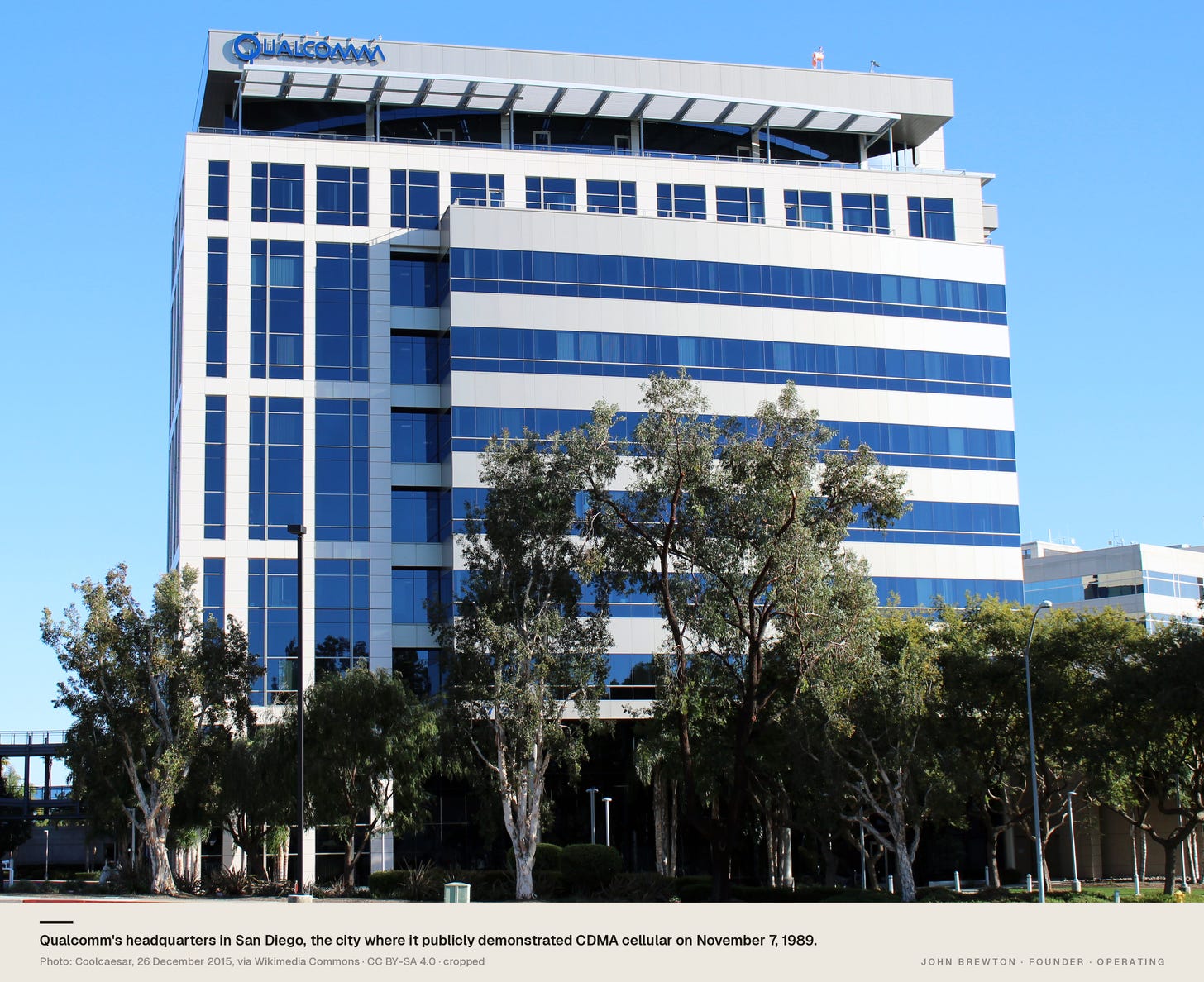
Qualcomm’s headquarters in San Diego, where it publicly demonstrated CDMA cellular on November 7, 1989. Photo: Coolcaesar / Wikimedia Commons, CC BY-SA 4.0.
The demo worked, and CDMA became the industry standard IS-95 in 1995. Levy's summary is the plain version of the whole decade. To prove CDMA, "Qualcomm had to develop chips and build a commercial phone and base station." So for most of the 1990s Qualcomm made the chips, the phones, and the base stations carriers put at their cell sites.

How to Build an AI Operating Team in Grok Bot: The Field Manual
You Don’t Have a Software Problem. You Have a Database Problem.
The Quiet Builders Are Coming. Great Companies Will Build Around Them.
The Sale
By early 1999, the base stations had become a problem. Ericsson sued Qualcomm in October 1996, and the two fought over the technology that would carry the world's 3G networks. An AT&T spokesman described it to The New York Times in February 1999 as a "financial, regulatory and political holy war," and the International Telecommunication Union said it couldn't certify a standard until the property rights were settled.
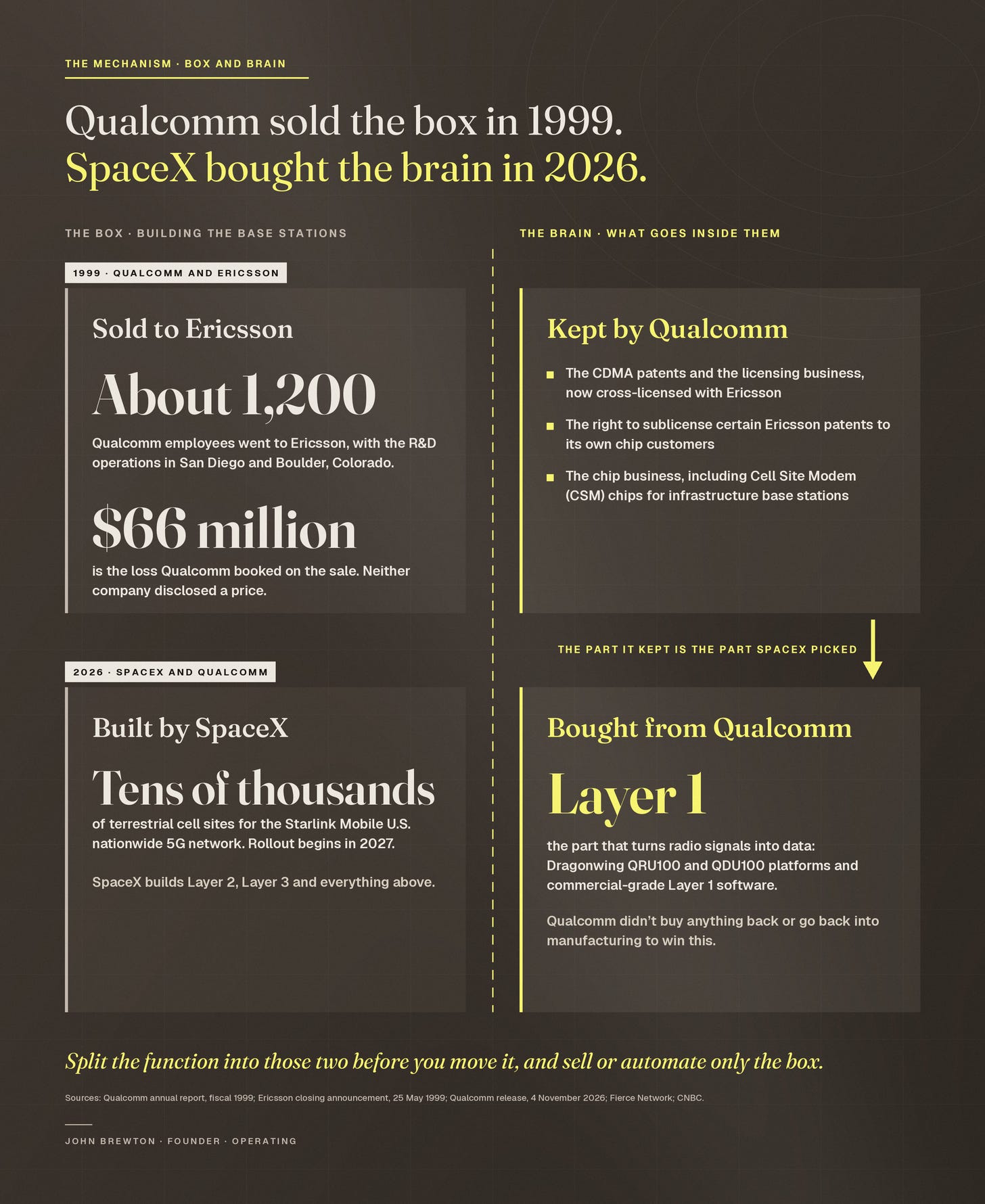
On March 25, 1999, the two companies announced how they'd end it. The agreement had four parts: joint support for a single CDMA 3G standard, a settlement of all the CDMA litigation, royalty-bearing cross-licenses between the two companies, and the sale of Qualcomm's terrestrial base-station business to Ericsson.
The sale closed in May. Ericsson received the R&D operations in San Diego and Boulder, Colorado; selected customer commitments; and, per Ericsson's closing announcement on May 25, about 1,200 Qualcomm employees. Qualcomm's annual report for fiscal 1999 said the company "has ceased its development and manufacture of terrestrial-based infrastructure base stations and has no present intention to re-enter that business."
Neither company ever disclosed a price. Ericsson paid in cash and took on certain liabilities, and Qualcomm booked a $66 million loss on the sale, the gap between the business's carrying value and what Ericsson paid, plus additional exit charges. Qualcomm also agreed to provide up to $400 million in financing for Ericsson's future CDMA equipment sales in markets like Brazil, Chile, Russia and Mexico. Ericsson later disputed the price, and by the following year's annual report the two were in arbitration.
Here's what Qualcomm kept: The CDMA patents and the licensing business, now cross-licensed with Ericsson, along with the right to sublicense certain Ericsson patents to its own chip customers. And it kept the chip business. In the same annual report, Qualcomm describes that business as selling modem chips for phones and "Cell Site Modem ('CSM') chips for infrastructure base stations." Ericsson bought the business of building the boxes. Qualcomm kept making the part that goes inside them.
Levy asked Jacobs why Qualcomm never became an American Huawei, building network gear and selling straight to customers. "We did think about that," Jacobs told him, "but we wanted CDMA to go worldwide." Levy's account is that competing with the carriers would have gotten in the way of that. Selling the boxes turned Ericsson from the company suing Qualcomm into a licensee.
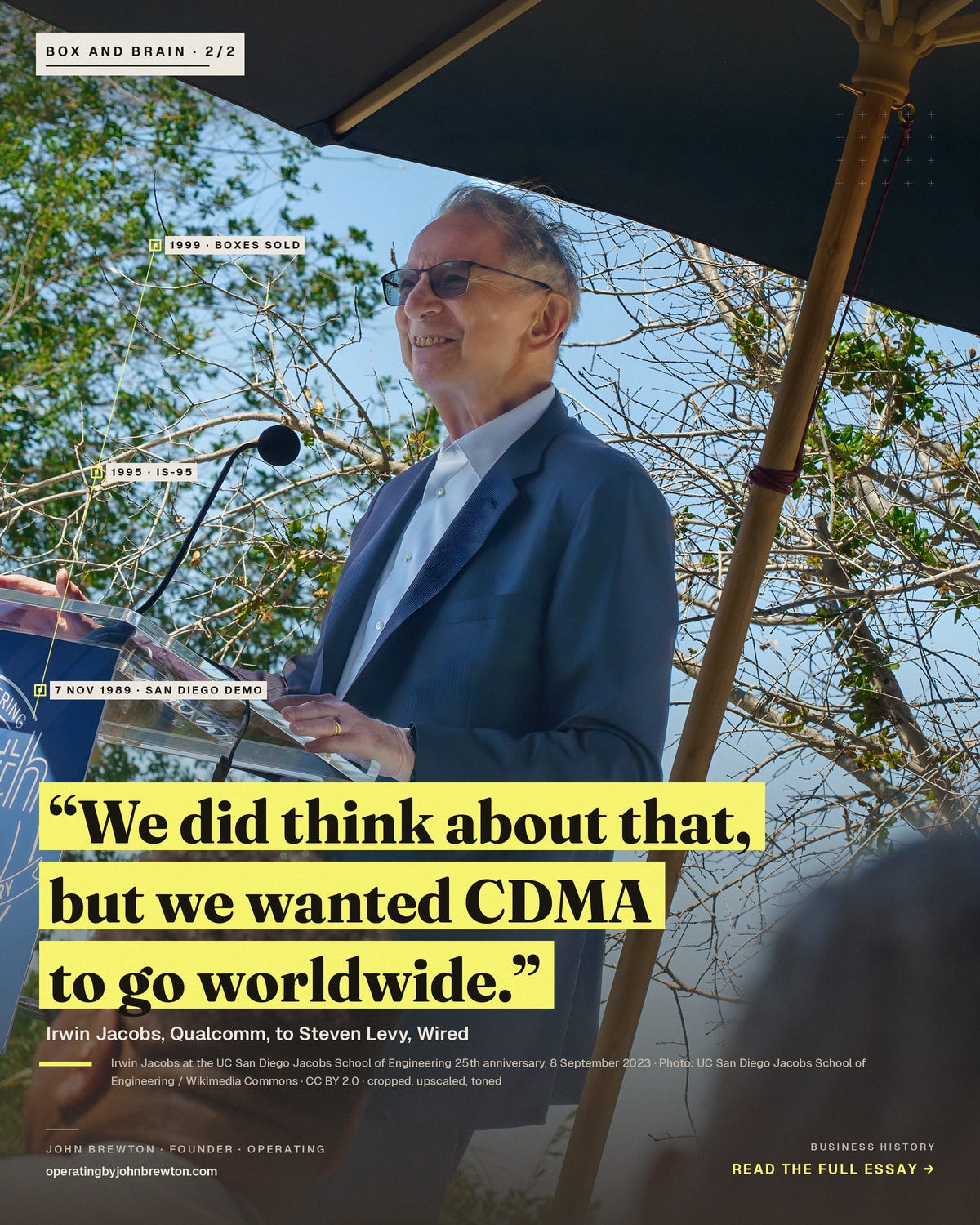
Photo: UC San Diego Jacobs School of Engineering, CC BY 2.0.
Qualcomm made the same split with phones a few months later. In February 2000 it sold its consumer phone business to Kyocera, received $242 million for it during fiscal 2000, and Kyocera agreed to buy most of its CDMA chips and software from Qualcomm for five years.
Meanwhile At The Cell Site…
Demand for the layer Qualcomm kept came back slowly, and Qualcomm spent years rebuilding infrastructure products and customer relationships to capture it. CNBC reported in October 2020 that Qualcomm started selling radio network products in 2018, focused on small cells, and was now expanding into full-size macro base stations. The same piece said Qualcomm "won't actually make any base stations or infrastructure, unlike companies such as Huawei, Ericsson, or Nokia." In 2022, Qualcomm bought Cellwize, a company that writes software to automate those networks.
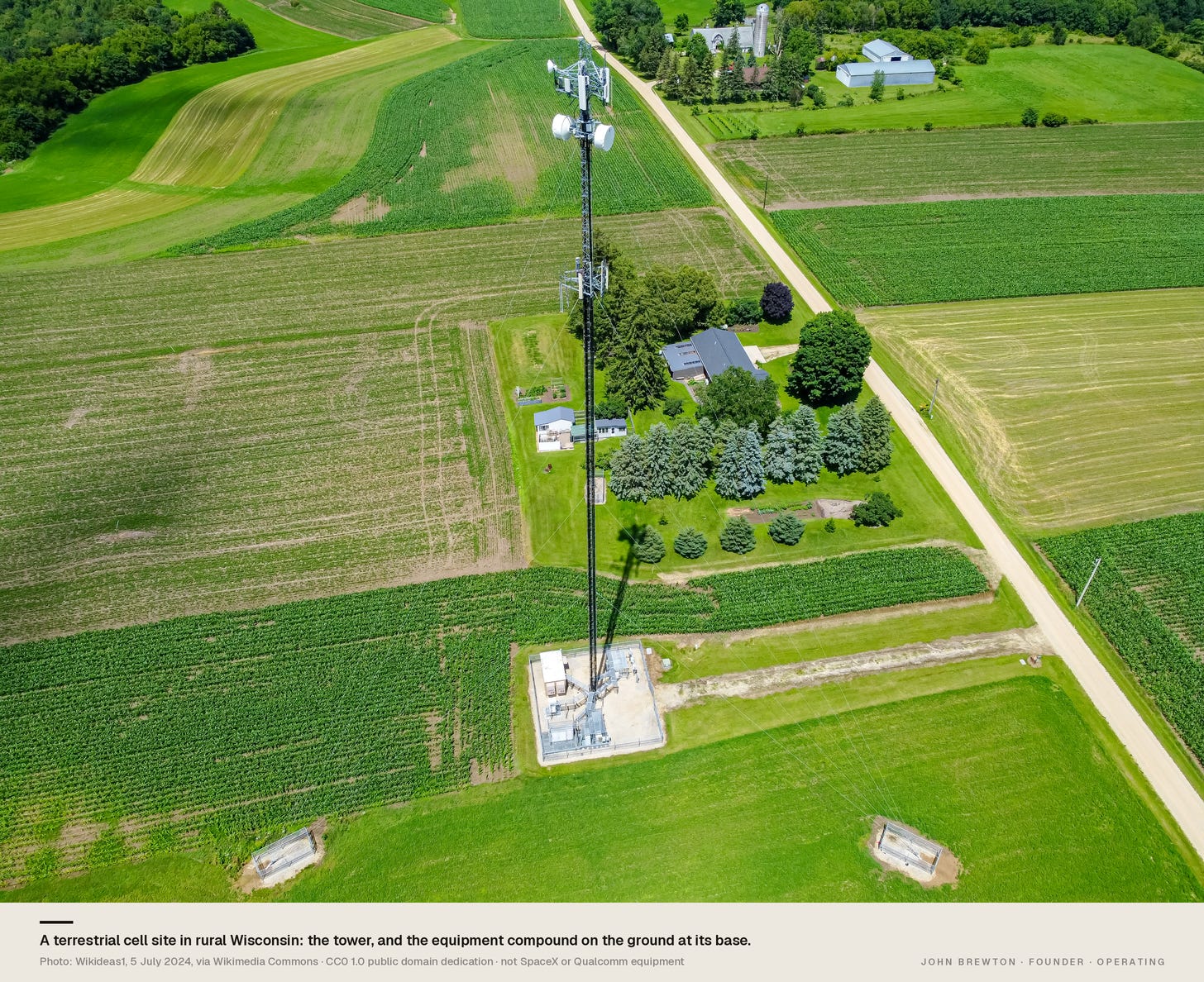
A terrestrial cell site in rural Wisconsin: the tower, and the equipment compound on the ground at its base. Photo: Wikideas1 / Wikimedia Commons, CC0.
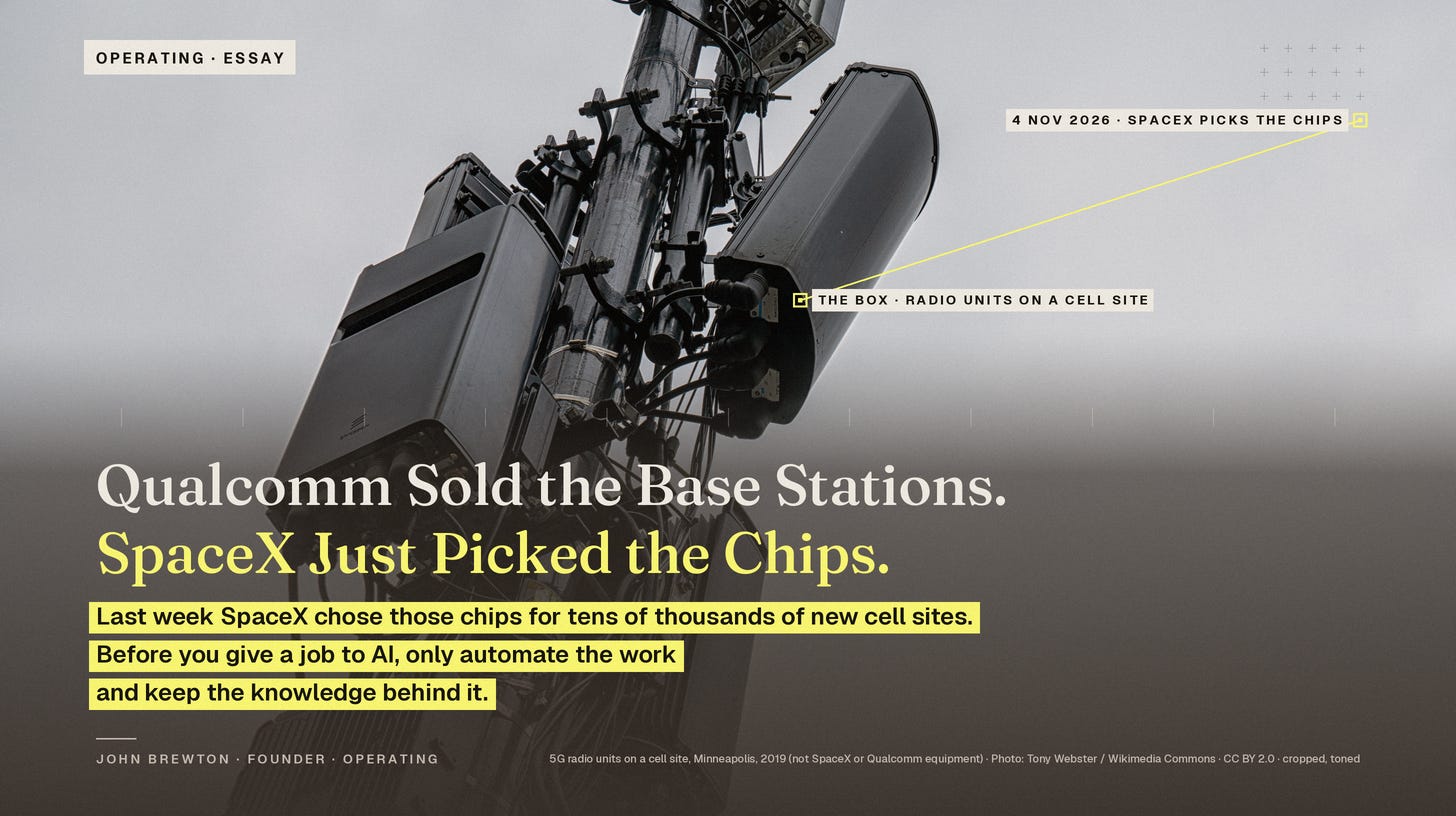
On November 4, 2026, that work landed with a customer most people associate with satellites. Per Qualcomm's release, SpaceX "has selected Qualcomm Dragonwing Cellular Infrastructure platforms for its Starlink Mobile U.S. nationwide terrestrial 5G network," using Qualcomm's QRU100 and QDU100 platforms "and commercial-grade Layer 1 software." These are cell sites on the ground, built to work alongside the satellites. Rollout begins in 2027, "with tens of thousands of sites deployed over the multi-year agreement." Michael Nicolls, a Starlink senior vice president, said in the release that the deal helps "accelerate our timeline to develop our base station end-to-end architecture." CNBC reported that financial terms weren't disclosed and that Qualcomm called it its largest 5G initiative to date.
Durga Malladi, an executive vice president at Qualcomm, gave the trade publication Fierce Network the cleanest description of the deal: "We don't build the boxes. They have to build the boxes, but we provide all the components and everything that goes inside that box." Per Fierce, Qualcomm supplies Layer 1, the part that turns radio signals into data, and SpaceX builds Layer 2, Layer 3 and everything above.
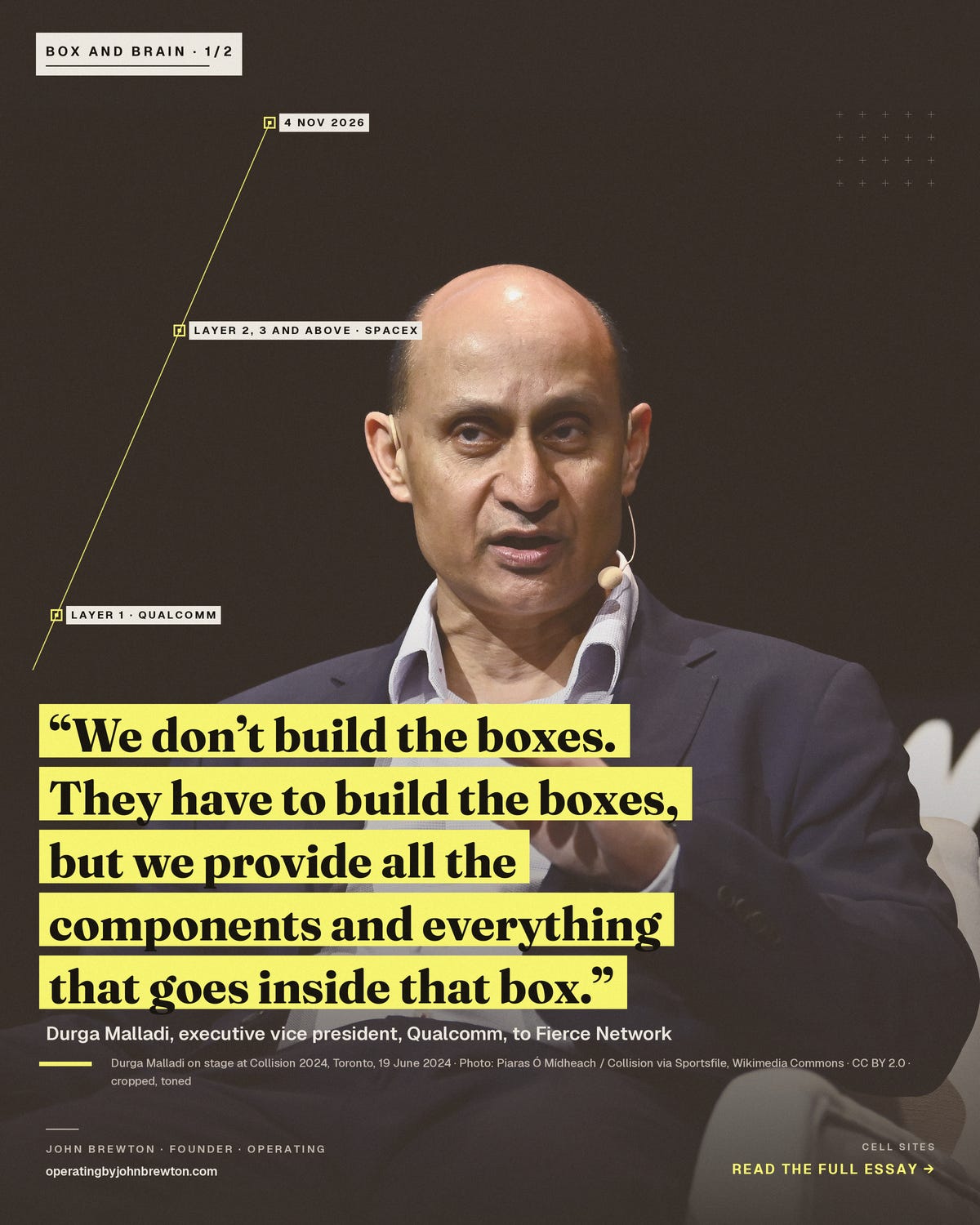
Photo: Piaras Ó Mídheach / Collision via Sportsfile, CC BY 2.0.
So SpaceX is building the boxes, tens of thousands of them, and buying the brain from Qualcomm. Qualcomm didn't buy anything back or return to manufacturing to win this. It sold the box in 1999 at a loss, kept the part the next customer would need, and that's the part SpaceX picked.
Here's what I would say to any operator about to hand a function to AI. Every function has a box and a brain. The box is the output: the tickets closed, the drafts written, the reports produced, the quotes sent. The brain makes the output right: the know-how, the customer data, the judgment calls, the quality standard, and the people who know why the output looks the way it does. Split the function into those two before you move it, and sell or automate only the box.