Stop grinding out posts one by one.
The Compound Content Studio™ is a live, 2‑week AI immersion where we build your Claude-powered content system that multiplies your ideas into an endless stream of on-brand content.
Instead of another course, this is a build-along: Operating by John Brewton and Unfazed Founder™ walk you step-by-step as you design, train, and launch a content engine that runs on autopilot while you run the business.
We kick off May 1st, and there are only 50 spots (25 of which have already been sold). If you want your content to compound rather than reset to zero every day, this is where you build the system that finally makes it happen.
This is the system John has built to create all of his content across social platforms. Jumpstart and scale your brand and content this May!
Start here.
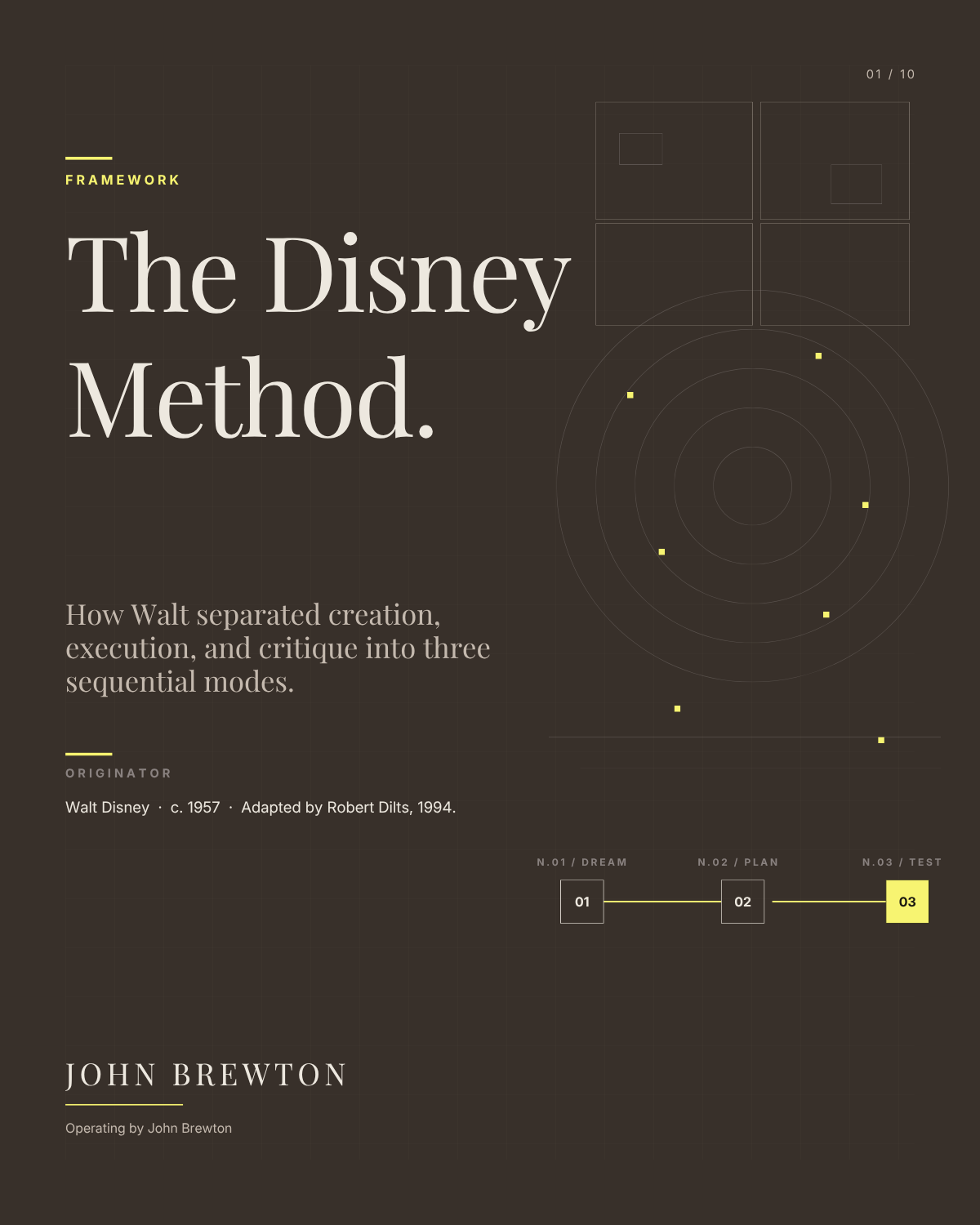
In 1957 Walt Disney built three rooms in his Burbank studio.
One for dreaming.
One for planning.
One for criticism.
Walt moved his concepts from room to room. The walls provided the discipline that meetings rarely do.
Robert Dilts named the practice the Disney Method in 1994. It became standard reading for design firms, advertising agencies, and product teams. Three modes, one sequence, never simultaneous.
The reason it worked is the reason it was needed. Most ideation fails the same way. Three voices speak at once. The dreamer suggests an idea. The critic dismisses it. The realist never gets a chance to test it. The room produces half-formed work, defended or killed before it matures. Mixing the modes is what kills the output.
Walt separated the rooms because a human can only hold one mode at a time. The architecture was disciplined and forced a mindset switch.
What has changed in the Age of Agents?
That constraint disappeared.
An agent can dream, plan, and critique inside a single prompt. So that is what most operators ask it to do. They open one chat window, paste a problem, and ask for a solution. The agent obliges. It returns a half-formed plan, defended and killed in the same paragraph. Creativity collapses inside the prompt designed to produce it.
The Disney Method matters more in the agent era, not less. The discipline that used to require three rooms now requires three agents and an orchestrator who refuses to let them overlap.
Three agents. One sequence.
The Dreamer agent generates fifteen candidate solutions with no constraints, no budgets, and no prior failures. The Realist agent takes the dream literally and designs a six-step build sequence with cost, owner, and a thirty-day milestone. The Critic agent pressure-tests the plan, names three failure modes, and demands a go or no-go decision. You hold the orchestrator’s seat to enforce the wall between rooms.
The tier translation is straightforward. Solo operators run three threads and never open two at once. The friction of opening a new chat is the wall. Startup founders assign each mode to a teammate and their agent stack, and rotate roles quarterly to break up expertise capture. SMB strategists build three named agents with locked system prompts and convene the team in the right room for the right mode.
Run the sequence once on a real problem. Then put it on the calendar. Friday Dreamer session. Monday Realist review. Quarterly Critic round.
Hope this helps.
- j -
Download the workbook
I built a ten-page workbook that walks the full method on one specific problem you are trying to solve. It includes the framework, the AI-era inversion, four worksheet exercises, and five copy-paste prompts that turn each room into a specialized agent.
New to Operating?
Check out these reader favorites:
Winning the Loser’s Game: The Creator Economy and the Companies We All Need to Build
0 to 55,000 - The First 90 Days Playbook - What I’d Do Differently Knowing What I Know Now
Become a paid subscriber to join the Operating Skool community and attend our weekly live Office Hour Q&A’s w/ John.
John Brewton documents the history and future of operating companies at Operating by John Brewton. He is a graduate of Harvard University and began his career as a Phd. student in economics at the University of Chicago. After selling his family’s B2B industrial distribution company in 2021, he has been helping business owners, founders and investors optimize their operations ever since. He is the founder of 6A East Partners, a research and advisory firm asking the question: What is the future of companies? He still cringes at his early LinkedIn posts and loves making content each and everyday, despite the protestations of his beloved wife, Fabiola, at times.


Here's the problem. A surplus of smart people. Thousands of smart posts that no one reads because no one has the time or the inclination. Thinking is not doing, and very soon, companies and people are going to recognize that AI can only get you so far. Human powers of persuasion, relationships, and politics are what drive ideas forward, not nice-looking decks culled from available data.
Also, for anyone interested, here is the associated LinkedIn post and carousel that visually summarizes the ideas: https://www.linkedin.com/posts/the-operator-john-brewton_the-disney-method-for-creative-problem-solving-ugcPost-7454137498030600192-RQvM