

Start Here
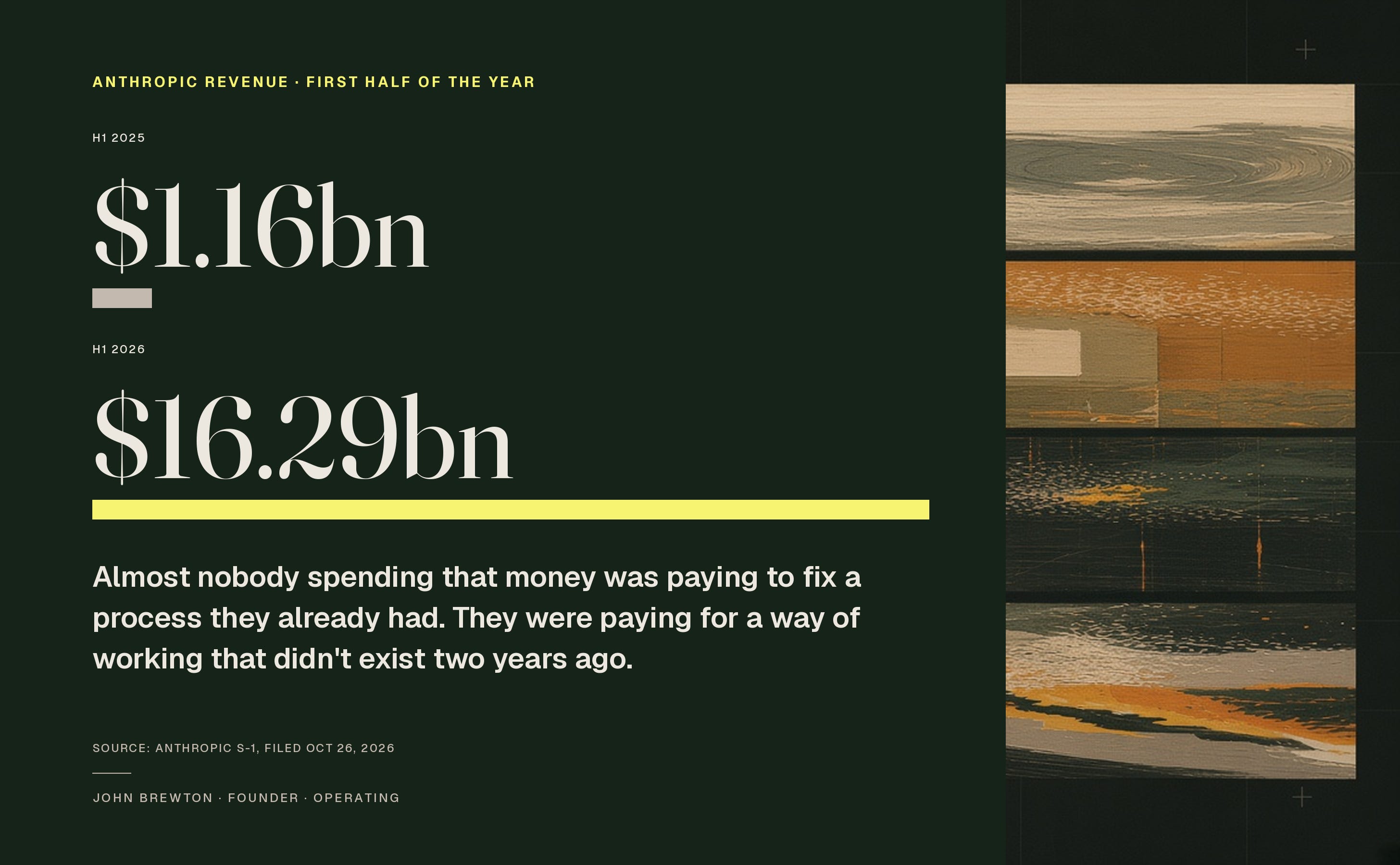
In the first half of this year, Anthropic took in $16.29 billion in revenue. A year earlier, the figure was $1.16 billion.
That number, from the S-1 the company filed on October 26, is market signal for all the founders building companies right now. Almost no one was paying for Claude to help them fix a process they already had, they were paying to enable their companies, teams and workflows to begin working in a fundamentally new way.
The same week of the S-1 release, Big Tech lost nearly $900 billion in value over two days, according to the Financial Times. Alphabet had the worst day in its history. Intel had its worst day ever.
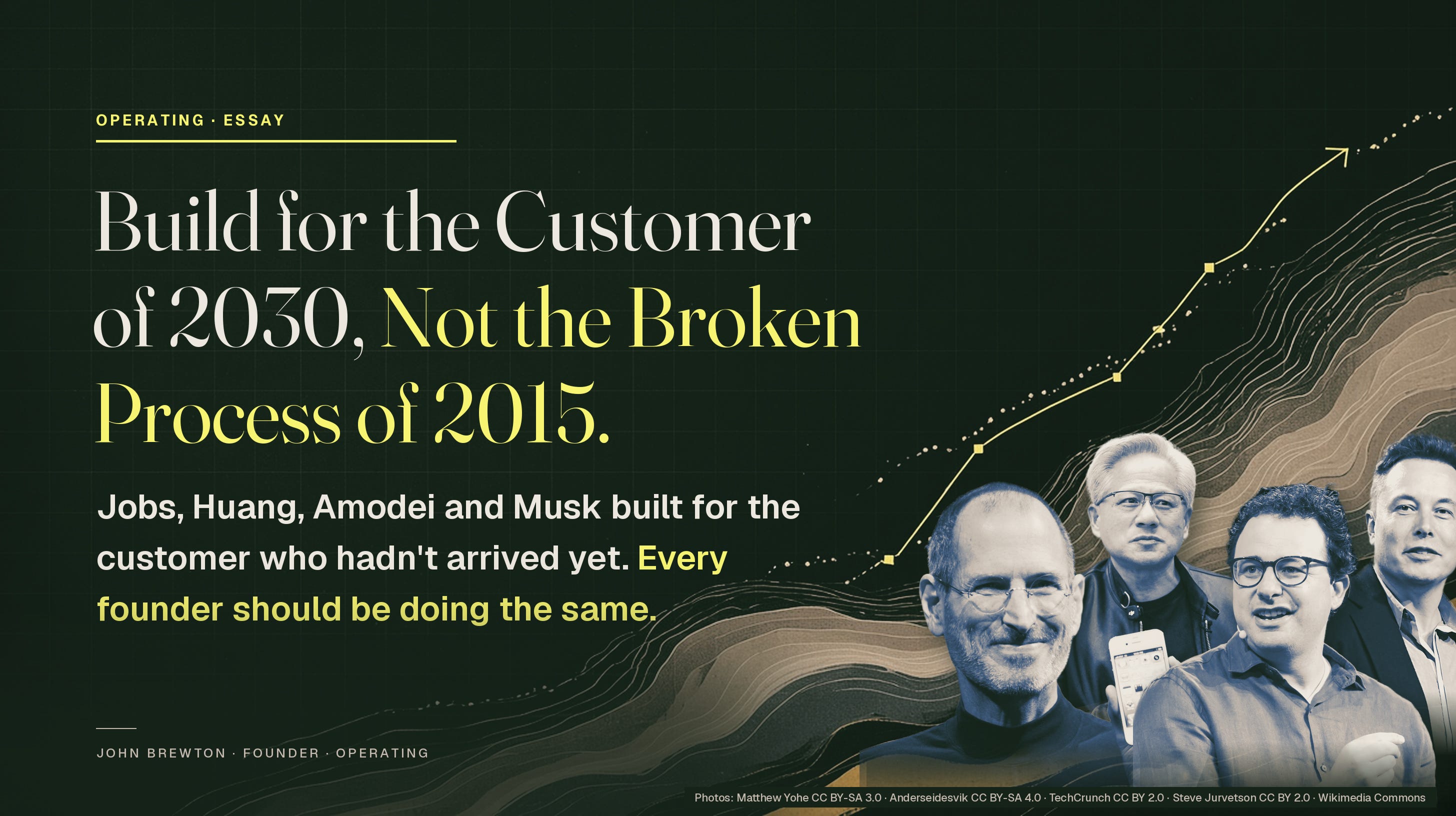
Companies need to build for what comes next, not solve problems for a version of the world that becomes less relevant every week. That’s the thesis of this essay: Build for the customer of 2030, not the broken process of 2015.
How to Build an AI Operating Team in Grok Bot: The Field Manual
You Don’t Have a Software Problem. You Have a Database Problem.
AI Was Supposed to Kill Consulting. Instead It Has Started a Golden Age.
The Quiet Builders Are Coming. Great Companies Will Build Around Them.
Customers Can’t Ask For What They’ve Never Seen
Steve Jobs understood this problem well. “You can’t just ask customers what they want and then try to give that to them,” he told Inc. in 1989. “By the time you get it built, they’ll want something new.” His reasoning was simple. Customers can’t anticipate what the technology can do, so they never ask for things they assume are impossible.
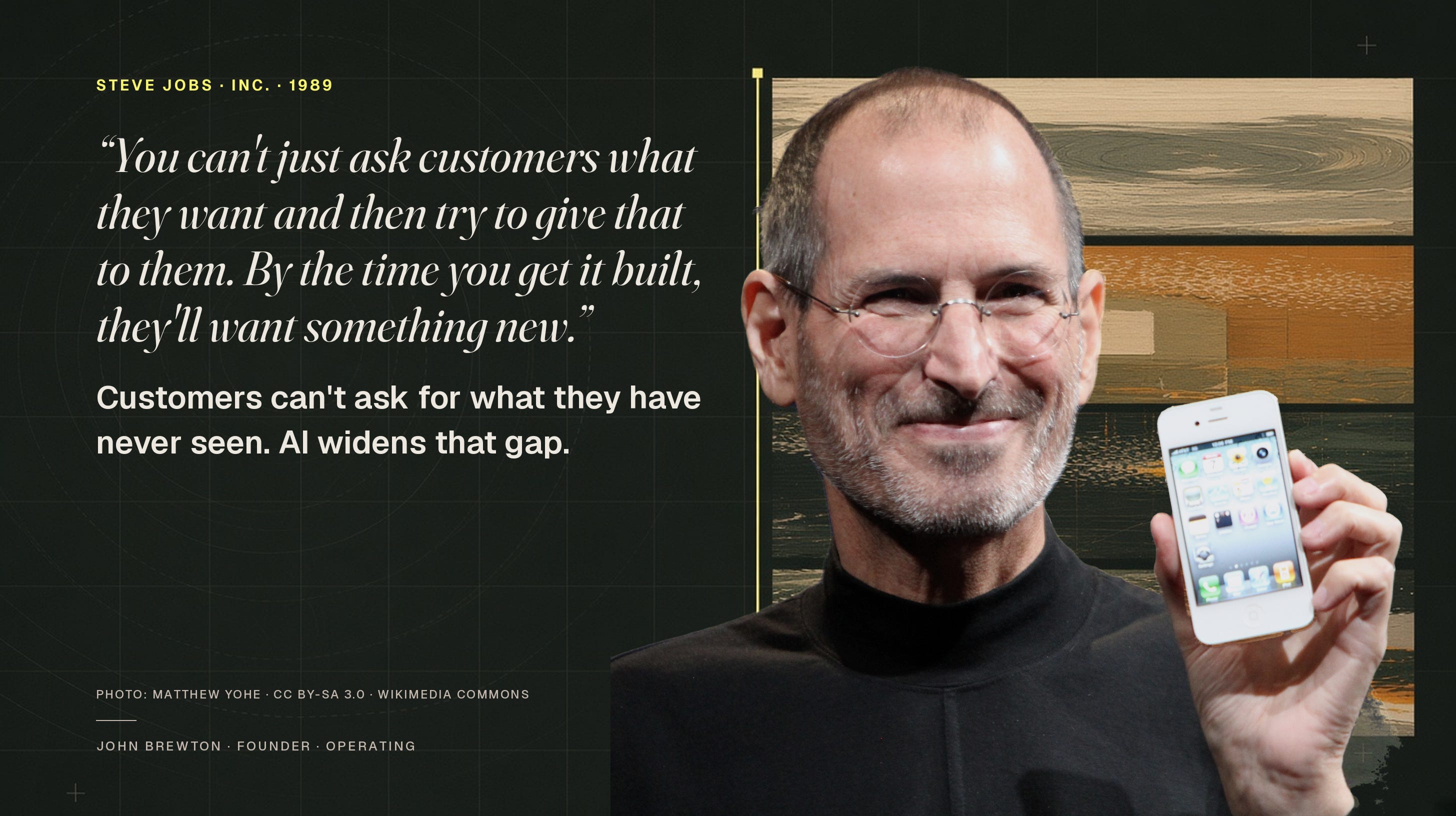
He held to the idea for the rest of his career. “Our job is to figure out what they’re going to want before they do,” he told his biographer, Walter Isaacson.
AI makes that discipline urgent. Most customers have never seen an agent close their books, file their permits, or run their support desk, so they don’t ask for one. They ask for a faster version of the process they already have. A company that builds only from that list of requests is building for the past, and falling further and further behind the future that rapidly unfolding.
The Growing Gap
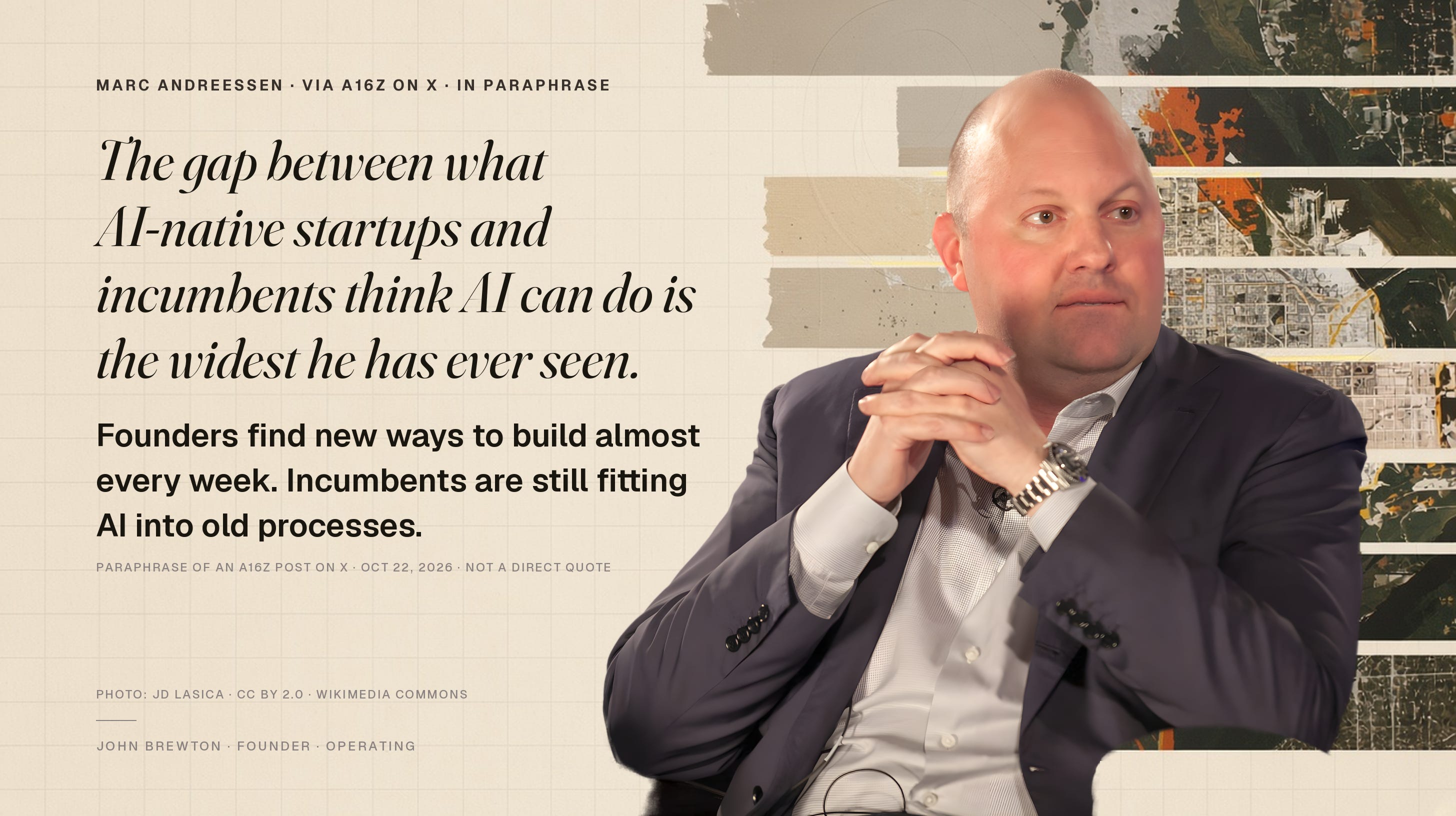
In a widely shared clip, Marc Andreessen described the gap between AI-native startups and incumbents as the widest he has seen in his career. Founders and operators find new ways to build and automate almost every week; it’s what they do. Established companies are still fitting the technology into the processes and systems and ways of thinking they already run.
He made a related argument in his X Article, “Replit and the dawn of the self-driving company.” The idea is a company where software does more and more of the operating work, and the people steer.
Startups are asking what the world will need next. Many incumbents are waiting for a slide deck that explains what they can buy today.
This Time Isn’t Different
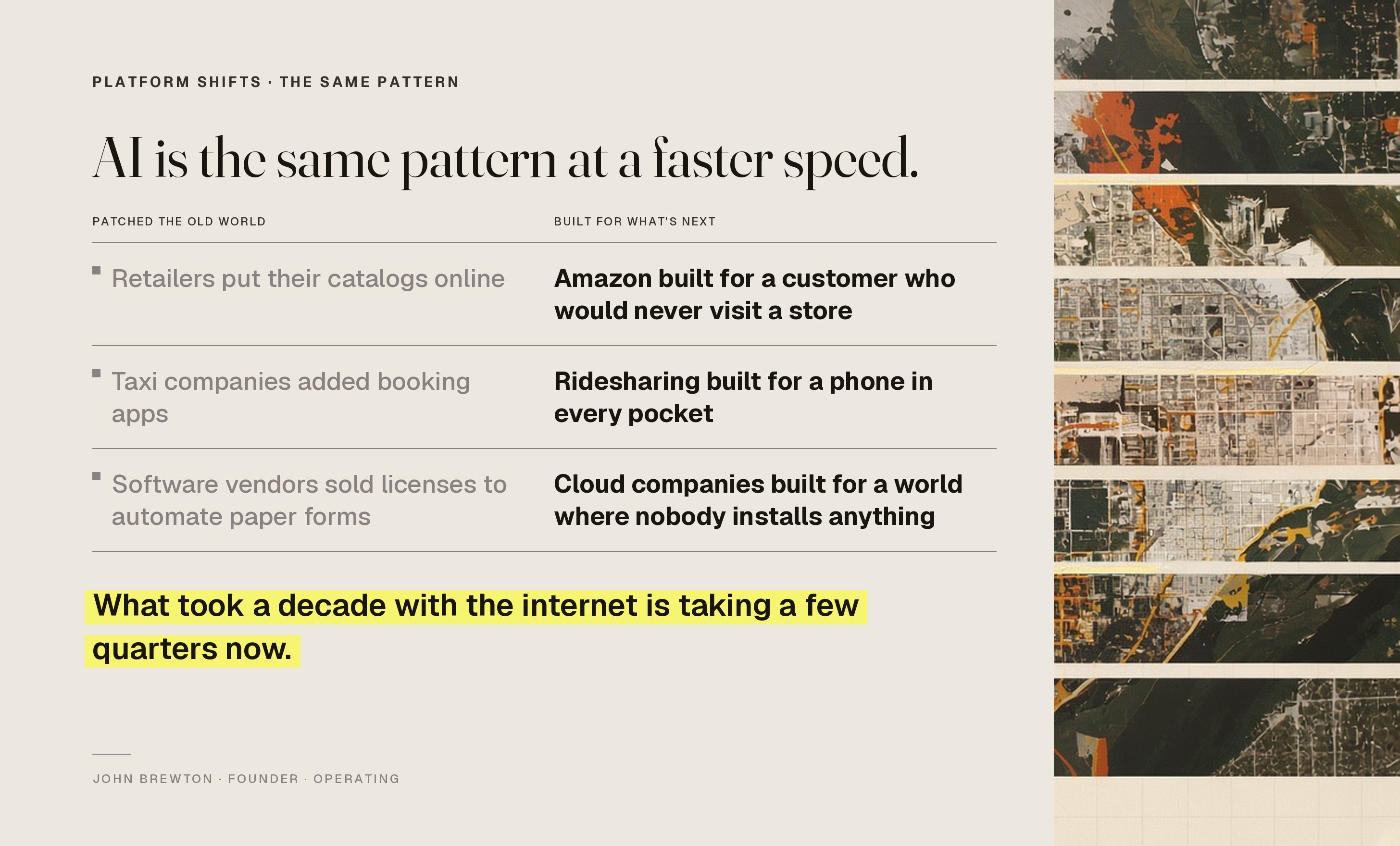
Every platform shift ends the same way. New companies get funded to build for the world the platform creates. Incumbents patch old workflows, and the patch buys them a few years.
Retailers put their catalogs online; Amazon was built for a customer who would never visit a store. Taxi companies added booking apps; ridesharing built for a phone in every pocket. Software vendors sold licenses to automate paper forms; cloud companies built for a world where nobody installs anything.
AI is the same pattern at much greater velocity. What took a decade with the internet is taking a year or less now.
If you like this, you might LOVE this one!

Elon Builds For the World That Hasn’t Happened, Yet
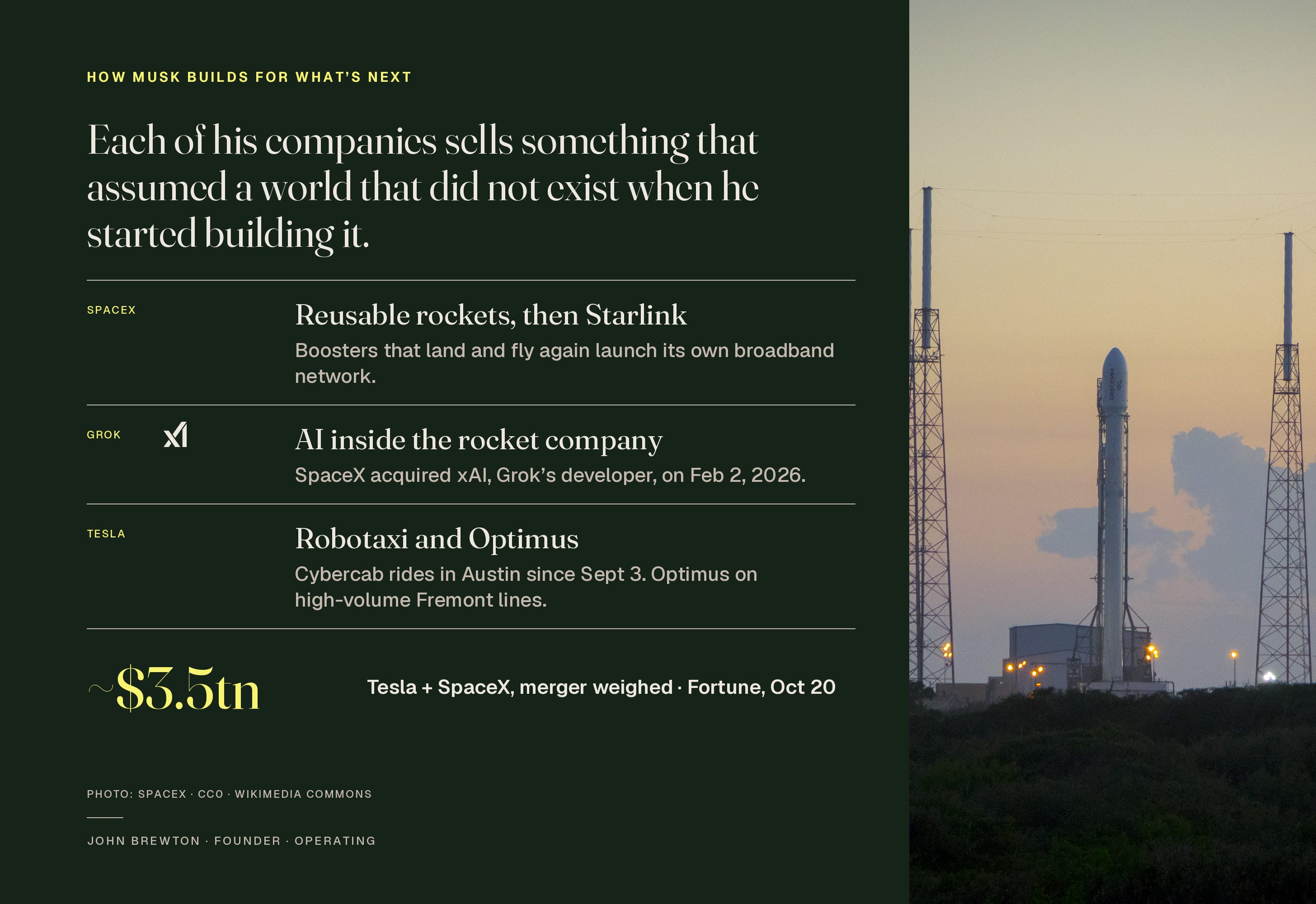
No one has made this bet more literally than Elon Musk. Each of his companies sells something that assumed a world that did not exist when he started building it.
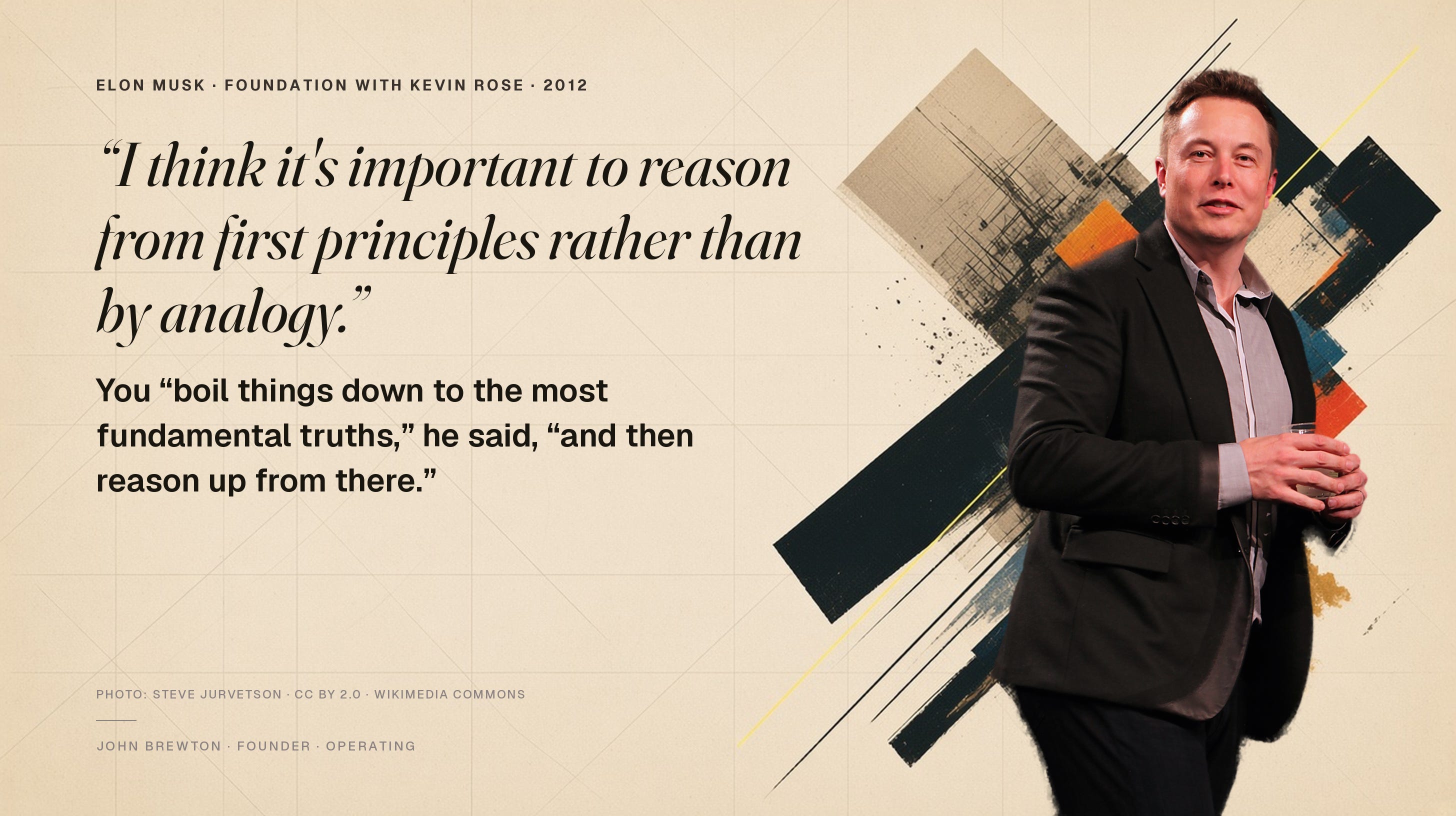
He has described the method many times. “I think it’s important to reason from first principles rather than by analogy,” he told the technology investor Kevin Rose in 2012. Reasoning by analogy, he said, means “we’re doing this because it’s like something else that was done, or it’s like what other people are doing.” First principles means you “boil things down to the most fundamental truths” and “then reason up from there.”
SpaceX is the clearest case. Launch customers asked for cheaper rides on rockets that were thrown away after one flight. SpaceX built boosters that land and fly again, then used that launch capacity to put up its own broadband network. Its filings now describe a company that “designs, manufactures, and launches reusable rockets” and runs a network “powered by thousands of Starlink satellites,” serving millions of customers.
The same filings list a third business, which SpaceX calls Super Intelligence and which runs Grok, the frontier model. SpaceX acquired Grok’s developer, xAI, on February 2, in a deal Reuters reported valued xAI at $250 billion and SpaceX at $1 trillion. Rockets, satellites and AI models now sit inside one company.
Tesla is running the same play on the ground. On September 3 it started Robotaxi rides in its Cybercab in Austin, and by the end of the third quarter its fleet had logged nearly two million cumulative unsupervised miles, according to its quarterly update. Production of Optimus, its humanoid robot, began on high-volume lines in Fremont. Musk told investors Tesla could start shipping the robots to outside companies by the end of next year, according to The Wall Street Journal. He was candid about the distance left: there is “still quite a lot of work to do with regard to the AI and the robot for it to be truly useful for open-ended tasks,” he said on the call, as reported by CNBC.
Now Tesla and SpaceX, worth about $1.5 trillion and $2 trillion, are weighing a merger that would combine about $3.5 trillion of value, according to Fortune. No terms have been agreed.
The lesson for operators sits in a line Musk gave Lex Fridman in 2023: “Physics is the law, everything else is a recommendation.” Most of what a company calls a constraint is a convention someone set years ago. A rebuilder asks which ones are physics.
Patching is a trap
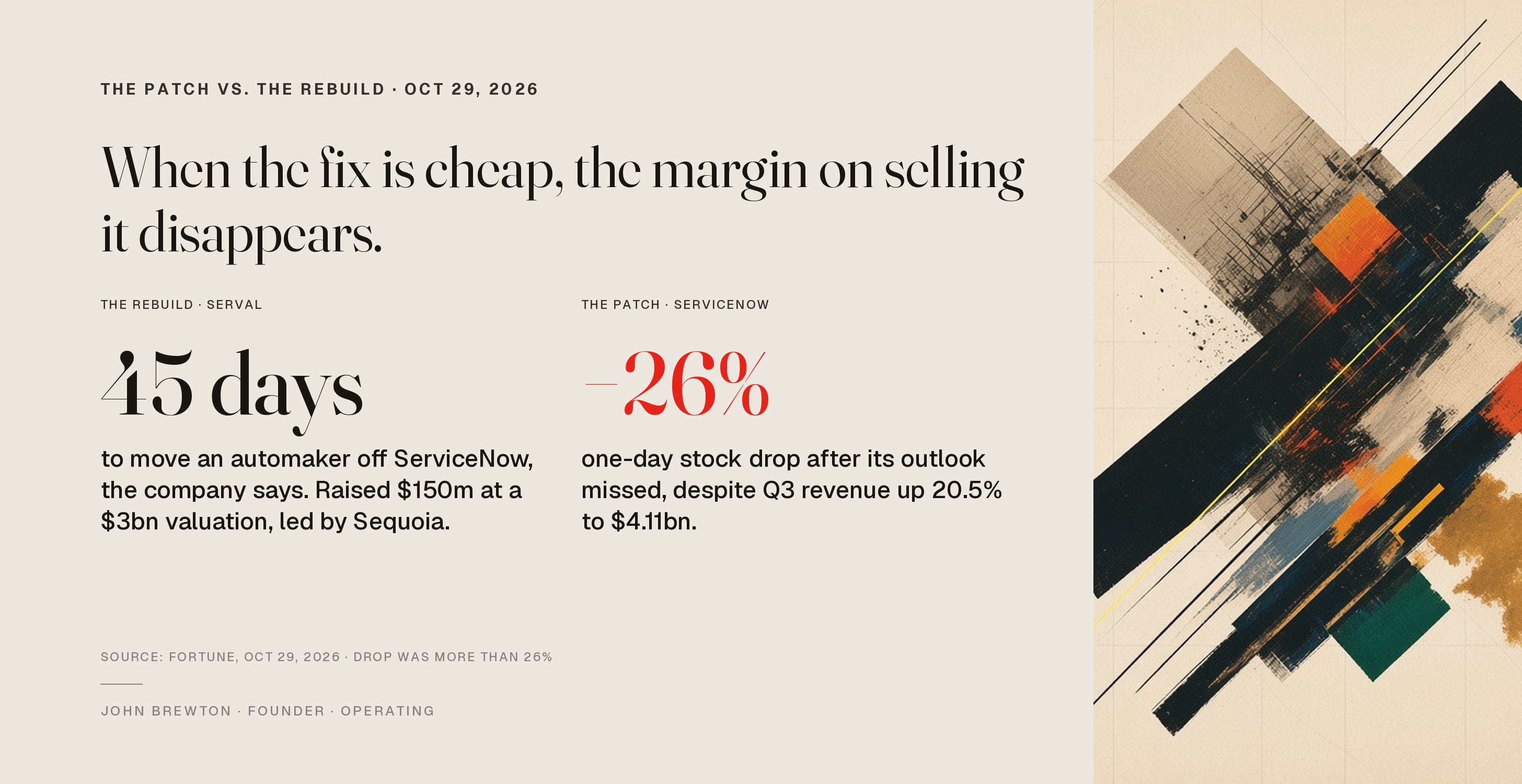
Here is the problem with fixing the old world: AI makes the old fix cheap. When the fix is cheap, the margin on selling it disappears.
Look at ServiceNow. Its third-quarter revenue rose 20.5% to $4.11 billion, a strong result by any normal standard. But its outlook missed, and on October 29 the stock fell more than 26%. The same week, Serval raised $150 million at a $3 billion valuation in a round led by Sequoia. Serval says it moved an automaker off ServiceNow in 45 days. The market was judging which company is built for how IT work gets done next.
Intel shows the other side. It guided fourth-quarter revenue to $15 billion to $16 billion, against $17.1 billion expected, citing weak PC demand as AI drives up memory costs, plus a fab explosion. The result was the worst day in its history.
Audi’s third-quarter net profit fell 87% to €95 million, and it cut its margin guidance to 3% to 5%. Different industries, same lesson: a model tuned for yesterday’s economics breaks when the economics shift.
The debt markets see it too. The Wall Street Journal reports that private-equity-backed companies face a $300 billion debt wall in 2028 and 2029, and software companies make up about a third of the riskiest loans. Many of those are businesses built to manage the pre-AI workflow.
I wrote about this in Enterprise Software Was Built for a World That No Longer Exists. The seat-based model assumed humans doing the work. Once agents do it, the seat stops being the unit of value.
What Capital Is Actually Funding
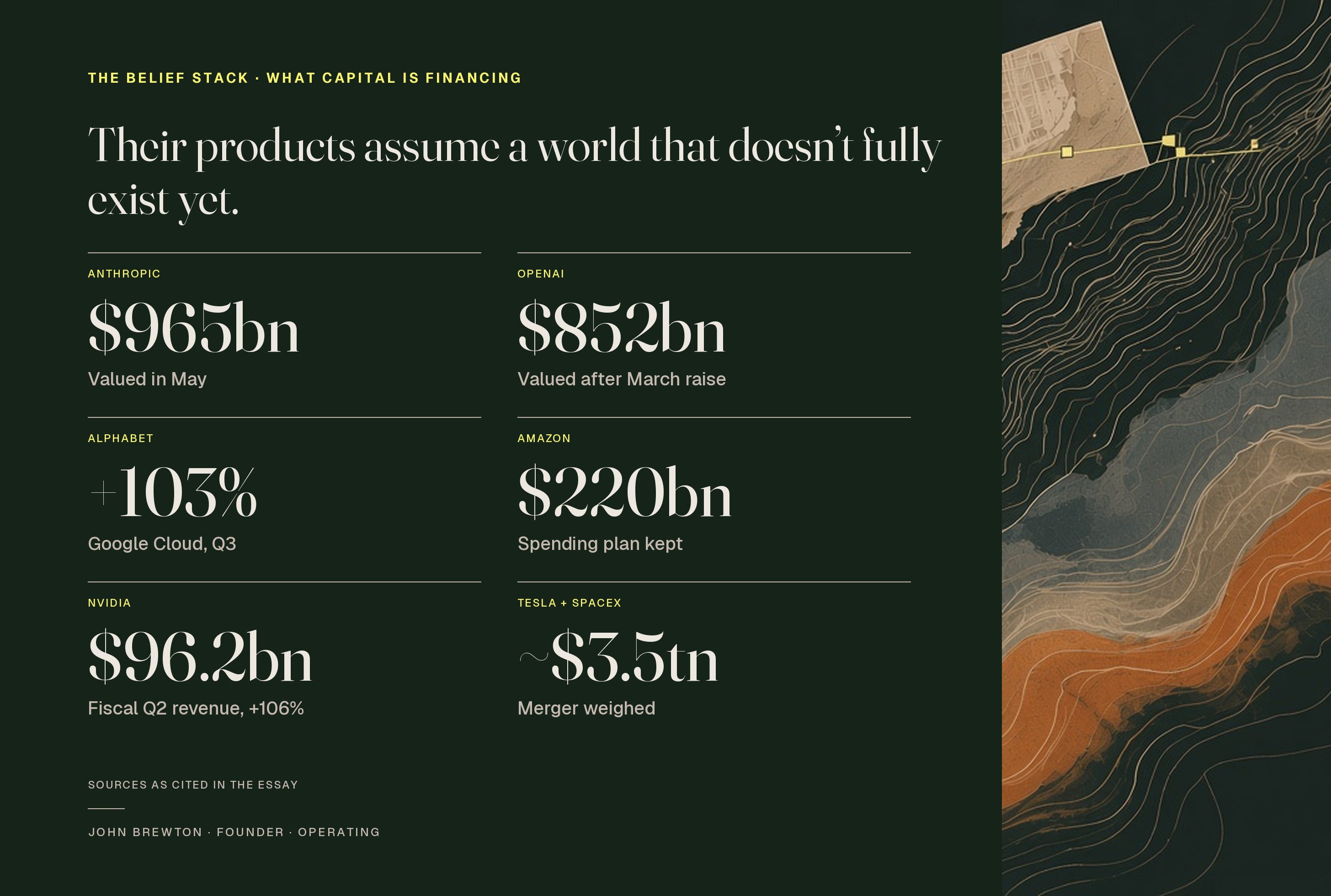
The companies with the highest valuations share one trait: their products assume a world that doesn’t fully exist yet.
Anthropic was valued at $965 billion in May. Its gross margin was about 85%, and it posted an operating loss of $693 million. The headline net loss for the first half was $80.7 billion, but roughly $72 billion of that was accounting charges on convertible notes. The company has committed hundreds of billions to compute; the FT puts the figure at about $800 billion, and Reuters at more than $600 billion.
OpenAI was valued at $852 billion after raising $122 billion in March. It reached about $50 billion in annualized revenue in September.
Alphabet grew third-quarter revenue 25% to $127.6 billion, and Google Cloud more than doubled, up 103% to $30.7 billion. It also posted negative free cash flow of $9.07 billion, its first negative quarter as a public company, while keeping capex guidance at $195 billion to $205 billion.
Amazon kept its $220 billion spending plan even as trailing free cash flow swung to an outflow of $42.4 billion.
Nvidia reported fiscal second-quarter revenue of $96.2 billion, up 106%, with $89.0 billion from data centers.
Tesla and SpaceX, as described above, are weighing a combined company worth about $3.5 trillion.
None of this is advice to buy or sell anything. It is a description of my belief in what we should be building as builders, creators, founders, and operators. Investors are financing visions of how people will work, move, compute, and live, and they are financing them at a scale we haven’t seen.
The Capital Market’s Appetite Has Limits
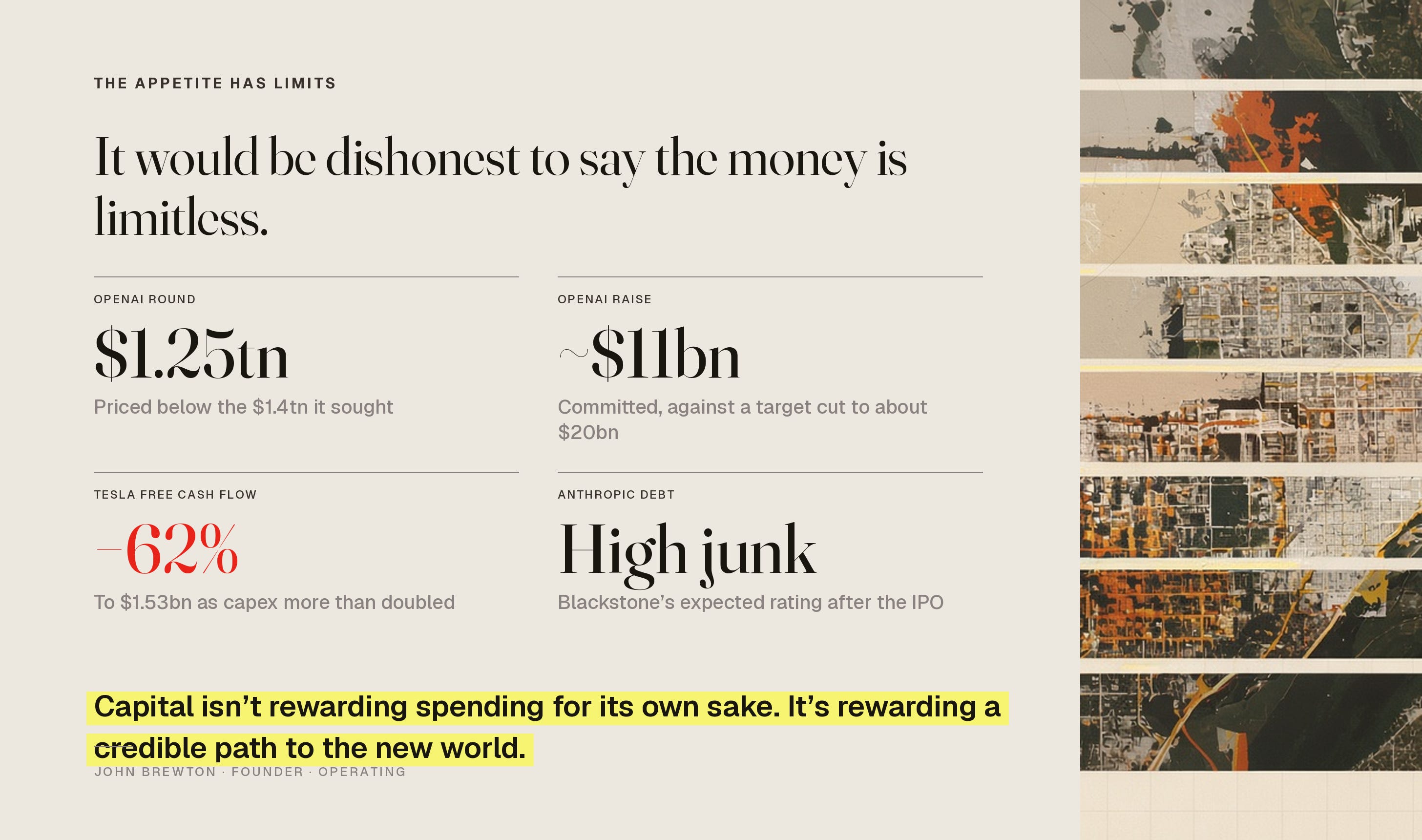
OpenAI’s new round is priced at $1.25 trillion, below the $1.4 trillion it sought, and the target was cut to about $20 billion with about $11 billion committed. Blackstone now expects Anthropic’s debt to be rated high junk after the IPO, not investment grade. Even Tesla’s free cash flow fell 62% to $1.53 billion as capital spending more than doubled on Optimus and other AI work, CNBC reported.
That discipline only sharpens my thesis. Capital isn’t rewarding spending for its own sake. It’s rewarding a credible path to the new world, and punishing both the patchers and the spenders who can’t show the path.
What The Next Customer Will Need
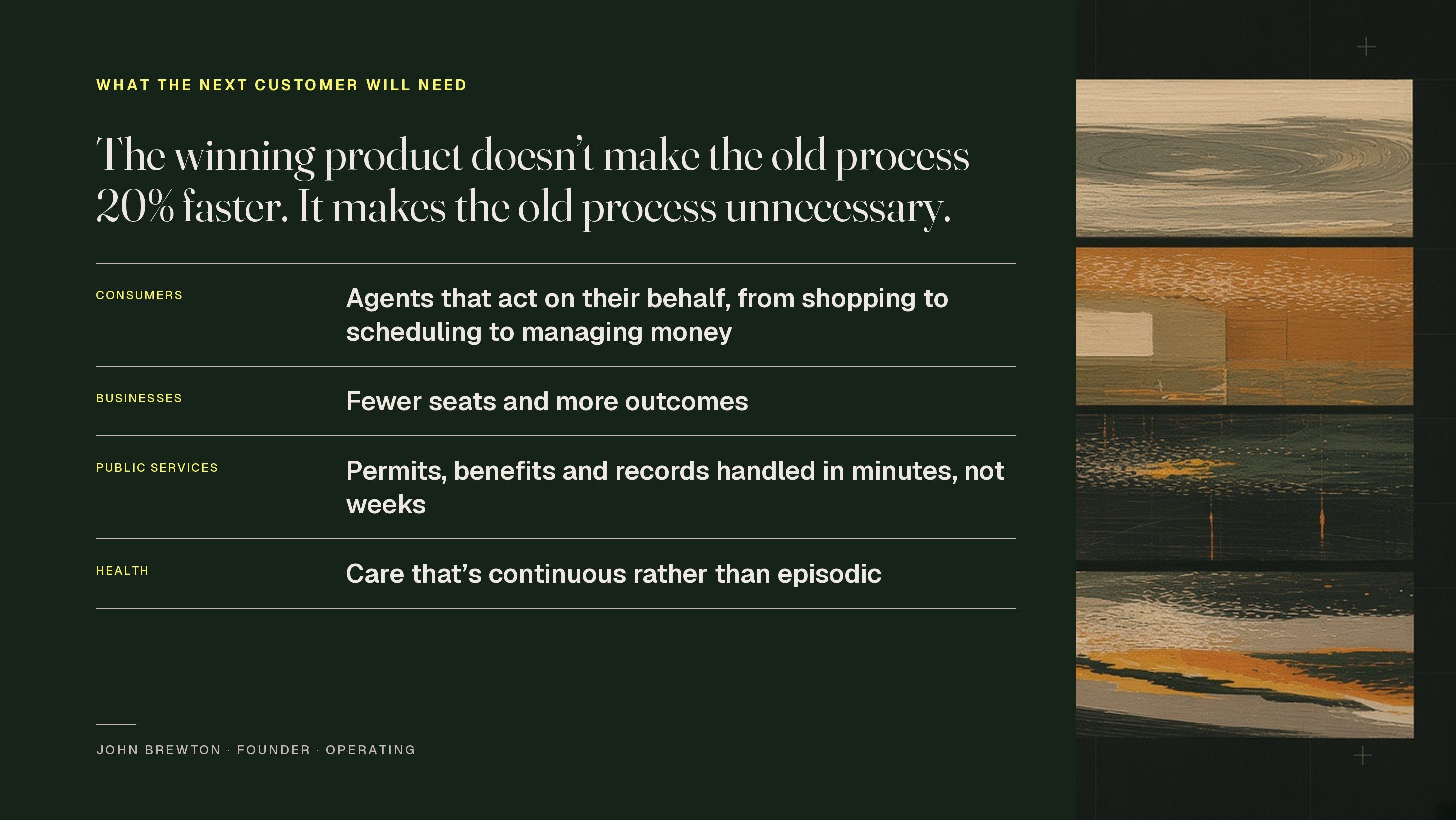
If you’re building, the question is what people and institutions will need once AI is ordinary. Consumers will expect agents that act on their behalf, from shopping to scheduling to managing money. Amazon is already building its own shopping agent rather than ceding the customer to outside ones.
Businesses will need fewer seats and more outcomes. Small teams will run what used to take departments or entire divisions. I made that case in Build a Company of Curators: the job shifts from doing the work to judging it.
Public services will need faster, simpler delivery: permits, benefits and records handled in minutes, not weeks.
Health will need continuous care rather than episodic care, with diagnosis, monitoring, and follow-up that doesn’t wait for an appointment.
In each case, the winning product doesn’t make the old process 20% faster. It makes the old process unnecessary.
Some old companies will falter. Some old jobs will go away. But every one of those losses sits next to a new market: new needs, new products, new ways of producing, new customers. Operators who see both sides of that ledger will build the companies that capture the markets that have fualtere and the capital that has flowed to new, yet to be determined, locations.
The Operator Playbook: Three Questions
Before you fund, build or buy anything this year, reason from first principles and test it against three questions.
Does this still matter if AI gets 10 times better? If your product’s value shrinks as models improve, you’re building a patch.
Who is the customer in 2030, and what will they never do again? Build for what they’ll stop doing, not what they do now.
Would an AI-native competitor build this from scratch? If they’d skip your process entirely, so will your customers, eventually.
If your plan fails two of these, you’re optimizing a world that’s leaving. For more on getting a team to actually make the shift, see How to Break Through the AI Adoption Wall.
The Takeaway
Companies are becoming tech stacks. We are all becoming companies. The tools to build for the next world are available to almost anyone for a monthly subscription, while the giants carry the bill on their balance sheets.
The velocity of change has never been higher, and neither has the cost of looking backward or standing still.
So here’s my question: What are you building that only makes sense in the world that’s coming?
- j -
If you enjoyed this, you might LOVE this!

John Brewton documents the history and future of operating companies at Operating by John Brewton. He is a graduate of Harvard University and began his career as a PhD student in economics at the University of Chicago. Since selling his family’s B2B industrial distribution company in 2021, he has been helping business owners, founders, and investors optimize their operations.
Sources
Photo credits: Steve Jobs (Yohe, CC BY-SA 3.0); Marc Andreessen (Lasica, CC BY 2.0); Elon Musk (Steve Jurvetson, CC BY 2.0); Dario Amodei (TechCrunch, CC BY 2.0); Jensen Huang (Anderseidesvik, CC BY-SA 4.0); Falcon 9 (SpaceX, CC0).
Steve Jobs interview, Inc., Apr 1, 1989: https://www.inc.com/magazine/19890401/5602.html
Walter Isaacson, Steve Jobs (Simon & Schuster, 2011)
Anthropic S-1 coverage, CNBC: https://www.cnbc.com/2026/10/26/anthropic-ipo-live-updates-ai-s-1-filing.html
Anthropic financials, Investing.com: https://www.investing.com/news/stock-market-news/anthropics-ipo-a-close-look-at-ai-frontrunners-rapid-growth-spiraling-costs-4972917
Anthropic debt rating, FT: https://www.ft.com/content/59383c7f-8d82-493f-bf01-d2e862a1018f
“How much is Anthropic really worth?”, FT: https://www.ft.com/content/d144a865-285a-490e-be11-f924ada8cbc7
OpenAI funding target cut (FT via Investing.com): https://www.investing.com/news/economy-news/openai-cuts-funding-target-by-10-billion-ft-reports-4988969
OpenAI raise (WSJ via Investing.com): https://www.investing.com/news/company-news/openai-raises-just-11bn-of-30bn-target-as-ai-investor-appetite-cools--wsj-4989165
Alphabet earnings, CNBC: https://www.cnbc.com/2026/10/29/alphabet-google-microsoft-msft-shares-today-earnings.html
Alphabet worst day, WSJ: https://www.wsj.com/tech/ai/alphabet-sheds-half-a-trillion-in-market-value-in-stocks-worst-day-ever-bde7bb6e
Amazon Q3, WSJ: https://www.wsj.com/tech/amazon-amzn-q3-earnings-report-2026-stock-a0b92f17
Amazon shopping agents, WSJ: https://www.wsj.com/cmo-today/amazon-shrugs-off-outside-shopping-agentsand-touts-its-own-6f00a8ef
Nvidia Q2 FY2027: https://nvidianews.nvidia.com/news/nvidia-announces-financial-results-for-second-quarter-fiscal-2027
Tesla/SpaceX merger talks, Fortune: https://fortune.com/2026/10/20/elon-musk-tesla-and-spacex-weighing-merger/
Serval vs. ServiceNow, Fortune: https://fortune.com/2026/10/29/serval-servicenow-fight-series-c-3-billion-valuation-sequoia/
Intel guidance, CNBC: https://www.cnbc.com/2026/10/30/intel-guidance-analyst-price-targets.html
Audi nine-month results: https://www.audi.com/en/media-releases/challenging-first-nine-months-audi-is-strengthening-its-measures-to-increase-competitiveness-18427
PE debt wall, WSJ: https://www.wsj.com/finance/investing/a-300-billion-debt-wall-is-looming-over-private-equity-backed-companies-d6359497
Andreessen: a16z post on X
Andreessen X Article: https://x.com/pmarca/status/2114751107293749731
Elon Musk on first principles, Foundation with Kevin Rose (2012): https://www.youtube.com/watch?v=L-s_3b5fRd8
; quoted in Business Insider: https://www.businessinsider.com/elon-musk-first-principles-2015-1
Elon Musk, Lex Fridman Podcast #400 (Nov 2023), official transcript at 00:40:01: https://lexfridman.com/elon-musk-4-transcript/
SpaceX S-1 financial notes (segments; xAI merger completed Feb 2, 2026), SEC: https://www.sec.gov/Archives/edgar/data/1181412/000162828026066880/R10.htm
SpaceX acquires xAI, Reuters, Feb 2, 2026: https://www.reuters.com/business/musks-spacex-merge-with-xai-combined-valuation-125-trillion-bloomberg-news-2026-02-02/
Tesla Q3 2026 Update (Robotaxi, Cybercab, Optimus): https://assets-ir.tesla.com/tesla-contents/IR/TSLA-Q3-2026-Update.pdf
Tesla Q3 earnings call, WSJ: https://www.wsj.com/business/autos/tesla-tsla-3q-earnings-report-2026-stock-a1dc9ce2
Tesla Q3 earnings, CNBC: https://www.cnbc.com/2026/10/21/tesla-tsla-q3-2026-earnings-report.html