
Operating Stories: The Complete Guide
Operating Stories: A weekly series dissecting the strategies of iconic companies to help us build our brands and companies

Operating Stories: A weekly series dissecting the strategies of iconic companies to help us build our brands and companies
I started Operating Stories with a simple premise. The best business lessons are not in textbooks. They are in earnings reports, shareholder letters, and the specific decisions operators made at the critical junctures in the history of their companies, the markets they serve, when new products were launched, and it wqs decided that new markets would be taken.
Over the past year, that premise has become a body of work.
Twelve articles. More than 80,000 words of original analysis.
Companies spanning luxury goods, Big Tech, insurance, railroads, skateboarding, e-commerce, industrial distribution, and athletic footwear. Historical operators from Carnegie to Buffett, to a 31-year-old British expat who opened a skate shop on Lafayette Street with $12,000.
Every article follows the same process:
Start with the financial data and the firm’s history.
Find the operating decisions that produced those numbers, responded to specific events, or embodied the belief of an essential strategy.
Then connect the pattern to historical parallels that reveal why the strategy works, how the company succeeded, where they stumbled, and why.
The goal is always the same. Give you, a founder, operator, builder, something you can use to make better decisions and produce better outcomes in your business.
This guide collects every Operating Stories piece in one place with a brief description of each. If you are new here, start anywhere that interests you. If you have been reading from the beginning, use this as a reference.
And at the end, I will explain what comes next with the series.
The catalog
Operating Economics: The Optimization Company (Amazon) October 29, 2025 · Free
Amazon’s operating margins quintupled from 2.4% to 11.5% between 2022 and 2025 while the company simultaneously invested over $100 billion annually in capital expenditure. This article traces that transformation through eight consecutive quarters of earnings data, then maps it to three historical parallels: Andrew Carnegie’s capital-intensity strategy in steel, Alfred Sloan’s divisional structure at General Motors, and Andy Grove’s inflection-point framework at Intel. The thesis is that Amazon, under Andy Jassy, is building a fundamentally different kind of corporation, one that grows revenue while shrinking its workforce through the deliberate substitution of technology for labor.
Alfred & Amazon: When Structure Becomes Strategy (Paid companion) Paid subscriber exclusive
The companion piece to The Optimization Company. This article goes deeper into the organizational architecture that enables Amazon’s transformation at scale. Andy Jassy is not just copying Jeff Bezos. He is executing Alfred Sloan’s century-old playbook for “coordinated decentralization,” the framework that made GM the world’s largest corporation.
When Amazon Channels Carnegie: Capital Intensity and the Competitive Moat (Paid companion) Paid subscriber exclusive
The second paid companion to The Optimization Company. Carnegie reduced the cost of producing a ton of steel by 79% over 27 years through obsessive efficiency, vertical integration, and a willingness to scrap brand-new equipment when superior technology emerged. Amazon is running the same play with robotics and warehouse automation.
Only the Paranoid Survive: Amazon’s Strategic Playbook from Intel Legend Andy Grove (Paid companion) Paid subscriber exclusive
The third paid companion. Andy Grove’s framework for identifying and acting on strategic inflection points explains why Amazon chose to invest aggressively into automation and AI infrastructure at the exact moment its margins were finally expanding. The article connects Grove’s concept of acting from strength, not from desperation, to Jassy’s decision to compress free cash flow by 60% in pursuit of long-term operational dominance.
Operating by Warren & Charlie (Berkshire Hathaway) November 28, 2025 · Free
Buffett and Munger did not build Berkshire by finding cheap stocks. They built it by marrying capital to operators who could run exceptional businesses for decades with almost no interference. This article examines four acquisitions spanning 53 years: See’s Candies, GEICO, Nebraska Furniture Mart, and BNSF Railroad. In each case, the pattern is identical. Find a business with durable economics. Pair it with a proven operator. Then stay out of their way. The piece includes a curated appendix of primary sources, including the original shareholder letters and the legendary 1.25-page NFM handshake deal.
Operating Stories: What Private Equity Taught Me by Never Investing in My Family’s Business
This is the most personal Operating Stories article. Between 2010 and 2012, private equity firms started calling about my family’s B2B industrial distribution company. Every conversation ended the same way: margins too thin, sales cycle too long, cost structure too heavy for debt-financed acquisition. But I took every meeting anyway. Each one was a masterclass in what a sophisticated financial buyer sees when they open your books. The article covers how we used those meetings to sharpen the business, reduced headcount from 102 to 61 while more than tripling revenue, and ultimately sold in 2021. It is a first-person account of what happens when you treat every potential investor conversation as an operating audit.
Operating Stories: The Luxury Brand Series

Operating Stories: Hermès and the Manufacturing of Scarcity February 8, 2026
Hermès builds its entire business model around saying no. No to faster production. No to wider distribution. No to the customer who wants a Birkin but has not earned the relationship. This article examines how a 187-year-old family-controlled company turned operational constraint into the most powerful brand-building mechanism in luxury. The financial data is striking: Hermès overtook LVMH by market capitalization while producing fewer goods, operating fewer stores, and spending less on marketing than any comparable luxury house. For operators, the lesson is not about luxury. It is about the operating discipline required to make scarcity structural rather than performative.

Operating Stories: Louis Vuitton and the Business of Collaboration February 15, 2026
Where Hermès restricts, Louis Vuitton absorbs and expands. For nearly three decades, collaboration has not been a marketing tactic at LV. It has been the operating system. This article tracks LV through three creative director eras, from Marc Jacobs (1997-2013) through Virgil Abloh (2018-2021) to Pharrell Williams (2023-present), and documents how LVMH’s Fashion & Leather Goods segment grew from €1.84 billion to €42.2 billion. Six operating principles are extracted, each stated as a directive. The piece includes era-by-era financial breakdowns, branded charts, the LV Collaboration Playbook infographic, and a sixteen-prompt AI Prompt Pack for applying the principles to your own business.
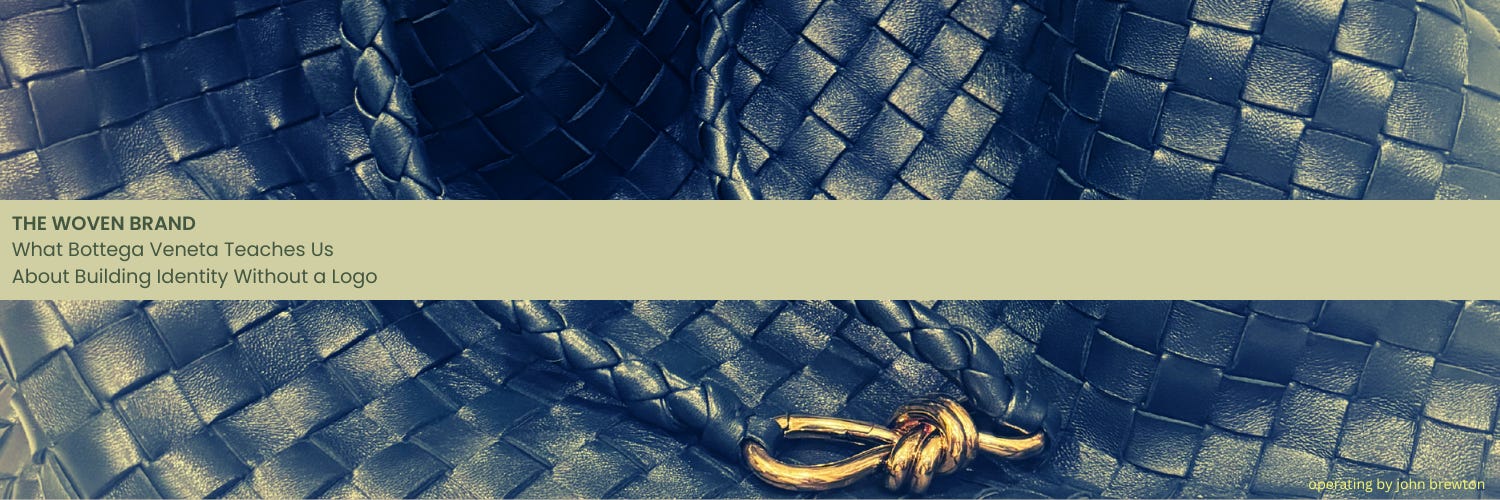
The Woven Brand: What Bottega Veneta Teaches Us About Building Identity Without a Logo February 22, 2026 · Paid
Bottega Veneta has no visible logo, no monogram, no signature hardware. Its brand identifier is a leather weaving technique called intrecciato. This article examines how Bottega built one of the most recognized luxury brands in the world by stripping away every conventional signifier of brand identity. The operating question at its center is one every founder faces: can you build recognition without a logo, without a catchphrase, without the shortcuts most brands rely on? Bottega proves the answer is yes, but only if the craft itself becomes the brand signal.

Operating Stories: Supreme’s Scarcity OS March 1, 2026 · Paid
Supreme generated $538 million in revenue and a 30%+ operating margin from roughly 17 stores and a single website. This article maps Supreme’s 30-year arc against the operating principles from the luxury trilogy (Hermès, LV, Bottega Veneta) and tracks the brand through three ownership eras: private (1994-2017), Carlyle ($1 billion, 2017), VF Corp ($2.1 billion, 2020), and EssilorLuxottica ($1.5 billion, 2024). The central lesson is what happens when a corporate owner tries to optimize a scarcity operating system for volume. VF Corp found out the answer, and it cost them roughly $600 million in value destruction.
Operating Stories: From Snowboards to $220B: The Tobias Lütke & Shopify Story February 1, 2026 · Free
In 2004, Tobias Lütke wanted to sell snowboards online. He had no credentials, no capital, and no work authorization in the country where he wanted to start a business. By 2006, other entrepreneurs did not want his snowboards. They wanted his software. This article tracks Shopify through 42 quarterly earnings reports across three distinct strategic regimes: the product-led land-grab (2015-2019), the pandemic super-cycle and logistics overreach (2020-2022), and the strategic refocus on software and profitable growth (2023-2025). The stock appreciated 4,600% from IPO to May 2020, crashed 70% in 2022, then recovered 200%. It is a field manual for understanding how capital markets discipline companies that forget their core competence.
Work with me directly.
You’ve read the framework. Most people stop there.
If you want to implement it — map your operating architecture, build your content system, design the AI-first workflows your business actually needs — this is how we do it together.
Three 1:1 strategic operating sessions with me.
Full access to the Operating Founders Skool community and all three course curriculam (43 DIY assets across 45 lesson plans)
The Operating Foundation,
The Brand Operating System,
The Content Engine.
Weekly live Zoom calls to keep you moving between sessions.
$99
This offer is for founders who are ready to stop reading about operating differently and start doing it.
The Man Who Invented Companies: Ronald Coase and the Origins of Operating July 18, 2025 · Paid
Ronald Coase did not build a company. He did not scale a startup. He did not even run a team. But in 1937, at age 27, he wrote a paper that explained why companies exist at all. This article traces Coase’s transaction cost theory to its practical implications for operators today. If companies exist because coordination costs are lower inside a firm than in the open market, then every technology that reduces those costs changes the fundamental shape of what a company should be. The piece is the intellectual foundation for much of what Operating by John Brewton explores.
The 4th Industrial Revolution August 21, 2025 · Paid
Artificial intelligence is the visible frontier, but it is not the whole story. This article examines the convergence of three forces reshaping how companies operate: technological acceleration driven by what Klaus Schwab termed the Fourth Industrial Revolution, economic restructuring that is changing how value gets created and captured, and an operating transformation that is making traditional strategic frameworks increasingly obsolete. For operators, the question is not whether these forces will change your business. The question is whether you will restructure before your competitors do.
What comes next: a new approach
The Nike Operating Stories piece, currently in development, represents the most ambitious research effort in the history of this series.
Previous articles focused on one company or one operator and worked outward.
The Nike project inverts that approach.
Instead of starting with one company, I started with an entire competitive market.
The research base for this article includes five separate research briefs about the companies (Nike, On Running, New Balance) and the market.
The central question in all this research applies far beyond sneakers. It is about what happens when the dominant company in an industry makes the same mistake it once exploited in its original competitor.
Nike’s own rise in the 1970s contains the exact blueprint that every subsequent challenger has executed. Find the underserved consumer. Build a visible product difference. Fill the channel gaps the incumbent ignores. Price to build brand equity rather than capture short-term volume.
But the article is just the center of a larger system designed to meet you wherever you are in your operating journey:
If you run a company doing $50 million in revenue, the Operating Audit will score your business against the same playbook that built Nike, On Running, and New Balance, and the Prompt Pack will turn your favorite AI tool into a working session partner that produces a 90-day action plan specific to your business.
The best operating lessons rarely live inside a single company.
They live in the spaces between companies.
Between the incumbent and the challenger. Between the strategy that worked and the strategy that replaced it. Between the financial data that tells you what happened and the operating decisions that explain why.
That is what Operating Stories has always been about and what it will strive to become as we move forward.
Thank you for your support and engagement in my work, it means the world.
More soon.
- john -
John Brewton documents the history and future of operating companies at Operating by John Brewton. He is a graduate of Harvard University and began his career as a PhD student in economics at the University of Chicago. After selling his family’s B2B industrial distribution company in 2021, he has been helping business owners, founders and investors optimize their operations ever since. He is the founder of 6A East Partners, a research and advisory firm asking the question: What is the future of companies?
Operating by John Brewton goes deep on what it takes to build, scale, and optimize modern companies. Operating Stories is just the beginning.
What Paid Subscribers Get:
3x Weekly Operating Notes: Short, practical notes on corporate strategy, operating excellence, and business history. Epic Operating Resource Articles: Extended case studies and frameworks (like the Carnegie and Sloan comparisons in the Amazon series, or the luxury trilogy’s brand strategy breakdowns) available exclusively to paid members. Paid Subs-Only Chat and Operating Working Group: Direct access to John and a community of operators tackling real challenges. Quarterly Live Operating Q&A: Community working sessions where we break down current strategies and answer your questions. Quarterly 1:1 Operating Sessions with John: Four 30-minute private sessions per year to work through your specific operating challenges.
Plans: Monthly: $17/month Annual: $95/year (save 54%) Operating Founder: $550/year (includes 1:1 sessions)
Most importantly, thank you for reading. I would love for you to join our growing community and help you solve your biggest operating conundrums in any way I can.
If you would like to work together, I have carved out some time to work 1:1 each month with a few top-notch Founders and Operators. You can find the details here.
Work with me directly.
You’ve read the framework. Most people stop there.
If you want to implement it — map your operating architecture, build your content system, design the AI-first workflows your business actually needs — this is how we do it together.
Three 1:1 strategic operating sessions with me.
Full access to the Operating Founders Skool community and all three course curriculam (43 DIY assets across 45 lesson plans)
The Operating Foundation,
The Brand Operating System,
The Content Engine.
Weekly live Zoom calls to keep you moving between sessions.
$99
This offer is for founders who are ready to stop reading about operating differently and start doing it.

John Brewton documents the history and future of operating companies at Operating by John Brewton. He is a graduate of Harvard University and began his career as a Phd. student in economics at the University of Chicago. After selling his family’s B2B industrial distribution company in 2021, he has been helping business owners, founders and investors optimize their operations ever since. He is the founder of 6A East Partners, a research and advisory firm asking the question: What is the future of companies? He still cringes at his early LinkedIn posts and loves making content each and everyday, despite the protestations of his beloved wife, Fabiola, at times.