

Hello Operators!
I have three stories for you today. They come from three companies, three different decades, and three very different industries. Each starts with a single line from the person running the place, and each asks the same question: where do a business's money and effort actually go?
How to Build an AI Operating Team in Grok Bot: The Field Manual
You Don’t Have a Software Problem. You Have a Database Problem.
The Quiet Builders Are Coming. Great Companies Will Build Around Them.
Berkshire Hathaway and the leaking boat
In July 1985, Warren Buffett decided to close the textile business that gave Berkshire Hathaway its name, and by year-end the job was largely done. His partnership bought control in 1965, when the company had a net worth of $22 million, all in textiles. In the nine years before he arrived, the merged Berkshire and Hathaway mills had produced $530 million in sales and a combined loss of $10 million.
Buffett never blamed the people. He put a longtime employee, Ken Chace, in charge and later wrote that Chace and his successor, Garry Morrison, were every bit as good as the managers of his best businesses. They reworked product lines, machinery and distribution. Berkshire even bought another mill, Waumbec, expecting synergy. Nothing worked.
I keep coming back to the capital spending. Over the years, Berkshire could have spent heavily on new equipment to lower variable costs. By the standard return-on-investment test, each proposal looked better than spending the same money at See’s Candies or the Buffalo News. Charlie Munger described the pitch in a 1994 talk at USC: the machine would “pay for itself in three years.” The problem was that every competitor was buying the same machines, and the savings showed up as lower prices across the industry. As Munger put it, “The cost reductions came through all right. But the benefit of the cost reductions didn’t go to the guy who bought the equipment.”
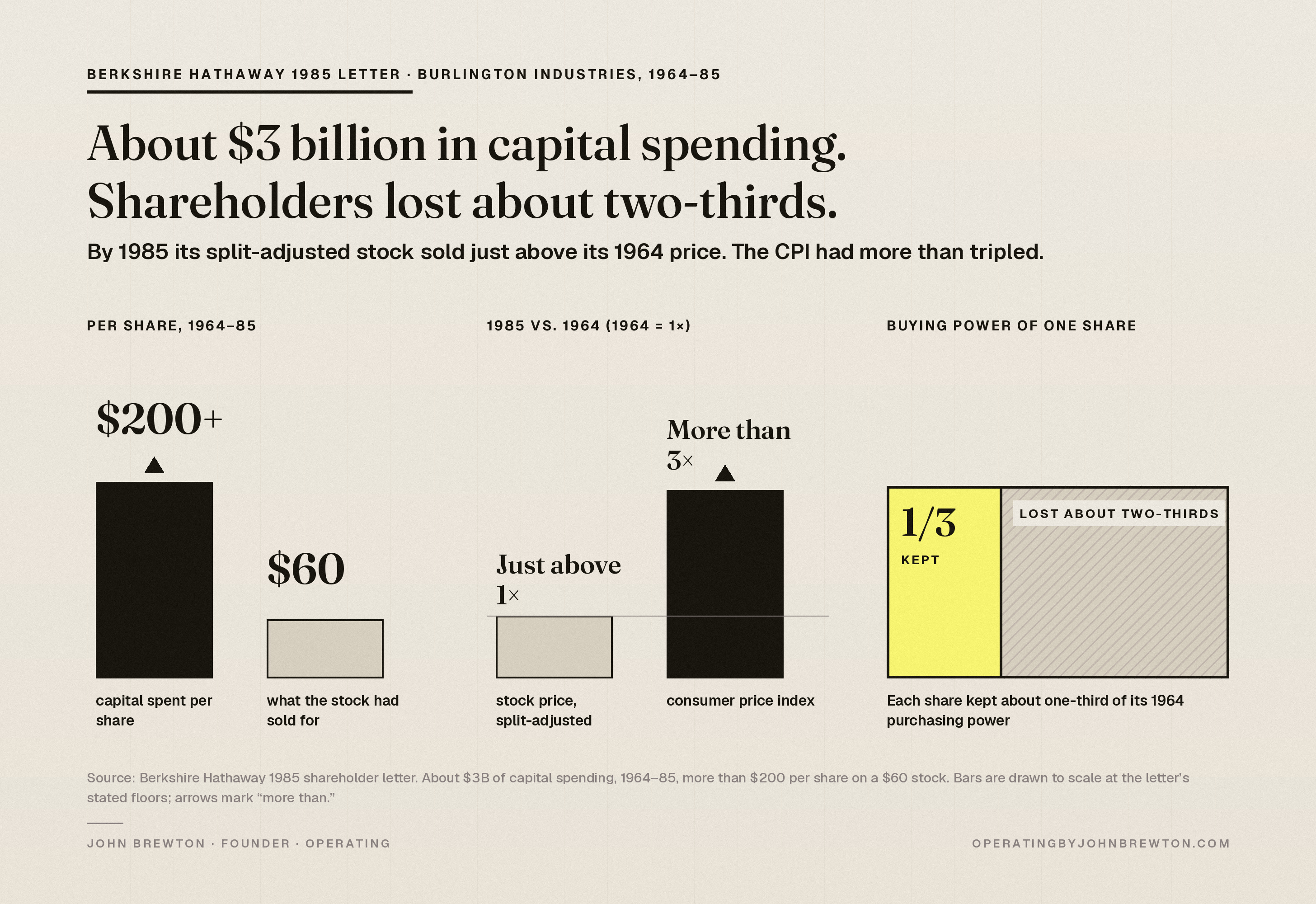
Buffett’s 1985 letter uses Burlington Industries, the largest U.S. textile company, to show where that road ends. Burlington spent about $3 billion on capital from 1964 to 1985, more than $200 per share on a stock that had been $60. By 1985, the stock, adjusted for a split, sold just above its 1964 price, while the CPI had more than tripled. Buffett surmised that Burlington’s capital decisions were “quite rational,” and its shareholders still lost about two-thirds of their purchasing power.
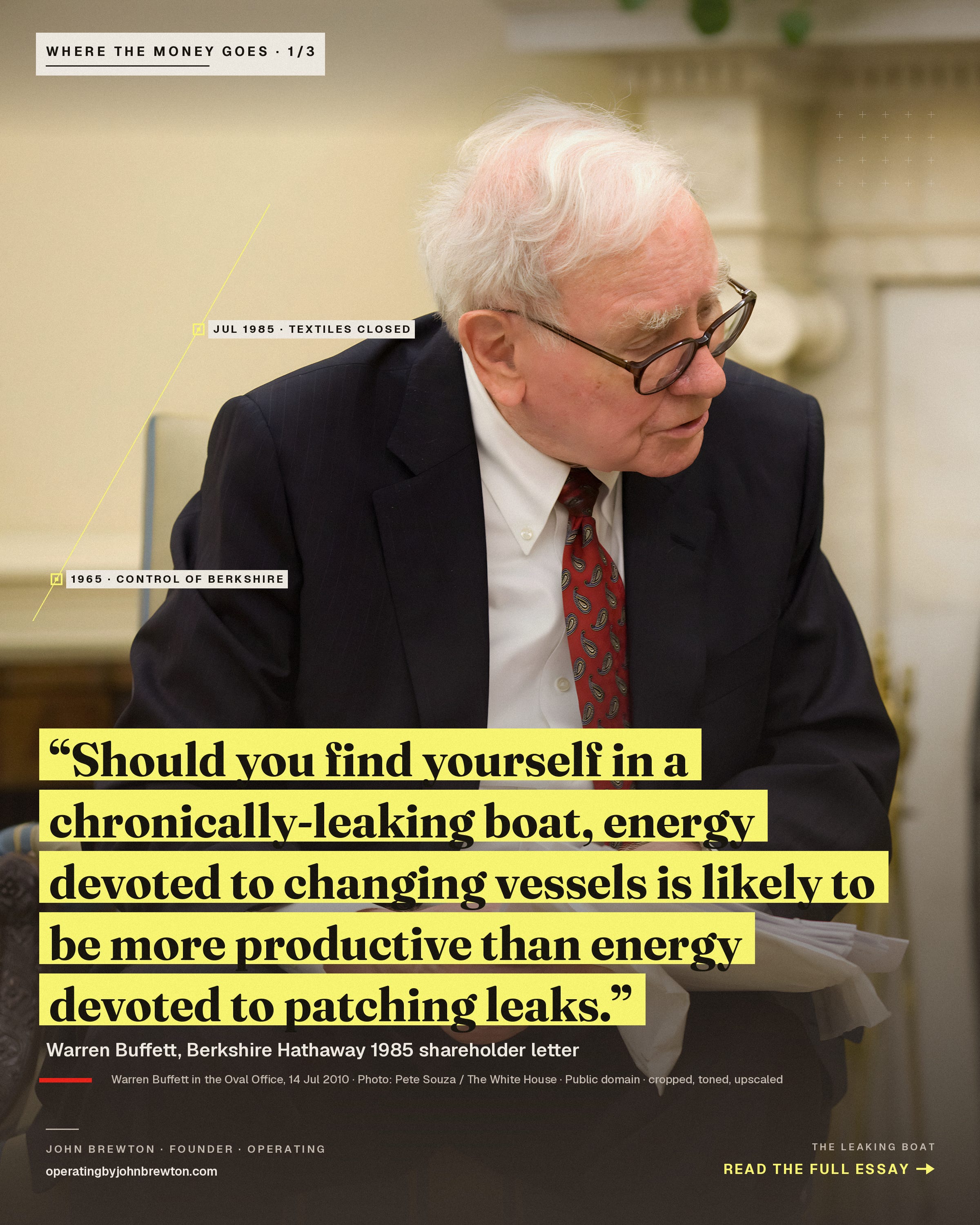
Buffett’s conclusion: “Should you find yourself in a chronically-leaking boat, energy devoted to changing vessels is likely to be more productive than energy devoted to patching leaks.”
That’s harder than it sounds, because patching feels like progress. Every new loom was a sensible decision on its own. What saved Berkshire was that Buffett had been moving cash out of textiles since 1967, when it helped fund the purchase of National Indemnity.
Heinz, Costco and a $300 table
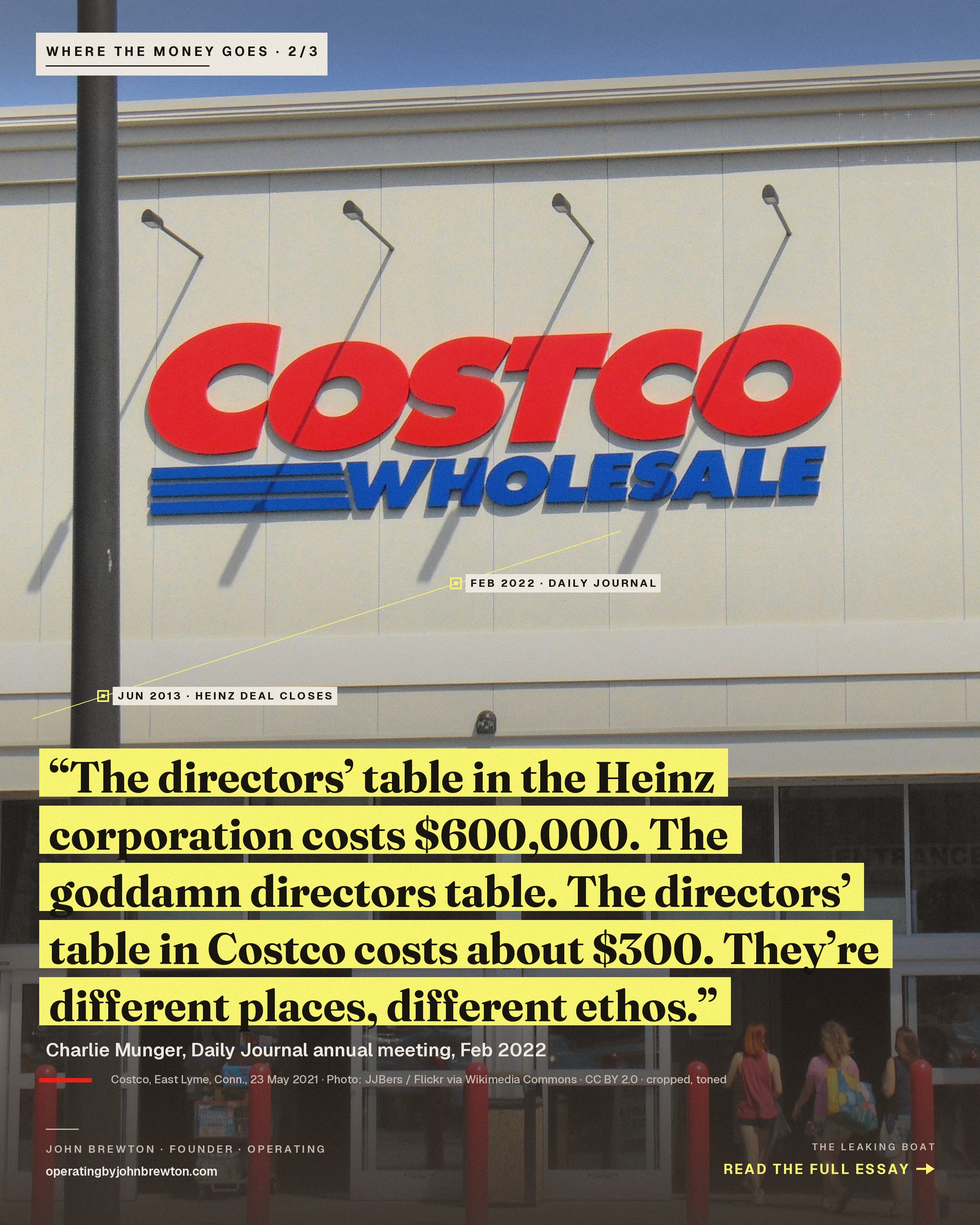
At the Daily Journal annual meeting in February 2022, Munger, who sat on Costco’s board for more than 25 years, compared two boardrooms. “The directors’ table in the Heinz corporation costs $600,000. The goddamn directors’ table. The directors’ table in Costco costs about $300. They’re different places, different ethos.”
He went on to say that when a company gets that fat, a buyer like 3G comes along and cuts it back to normal. That is exactly what happened at Heinz. Berkshire and 3G Capital closed their purchase of Heinz in June 2013, in a deal valued at about $28 billion. Fortune’s Jennifer Reingold reported that 11 of the top 12 executives were soon gone. In August, Heinz cut about 600 jobs, including 350 at its Pittsburgh headquarters. The company sold its corporate jets, merged two headquarters buildings into one, replaced private offices with shared tables, and moved executives who used to stay at Ritz-Carltons to Holiday Inns on a $45 per diem.
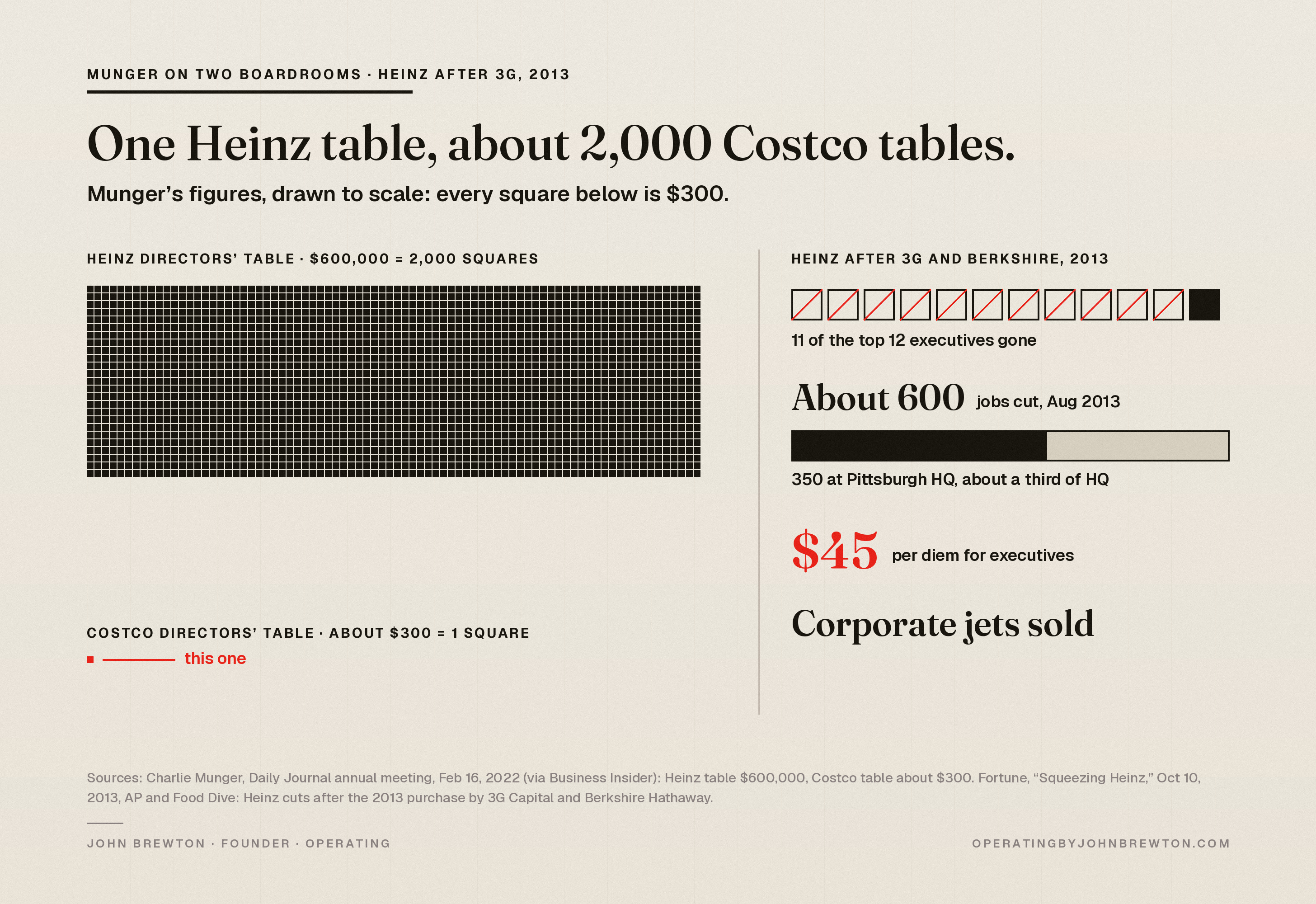
Here’s what I think matters. Costco never needed a 3G. Its culture kept the table at $300, so nobody had to walk in and lay off a third of headquarters to reset the cost structure. Heinz needed an outside owner to do in one summer what its own culture had stopped doing over many years.
Verizon and the 35 signatures
The newest story comes from Dan Schulman, who became Verizon’s CEO about a year ago after running PayPal. In a Fortune interview published November 16, he described the company he walked into as “very bureaucratic, very hierarchical, almost like the military, and very siloed.” Some decisions needed about 35 signatures before anything moved. That was one of the first things he blew up. “Surely we don’t need more than three or four people to sign something for it to move forward.”
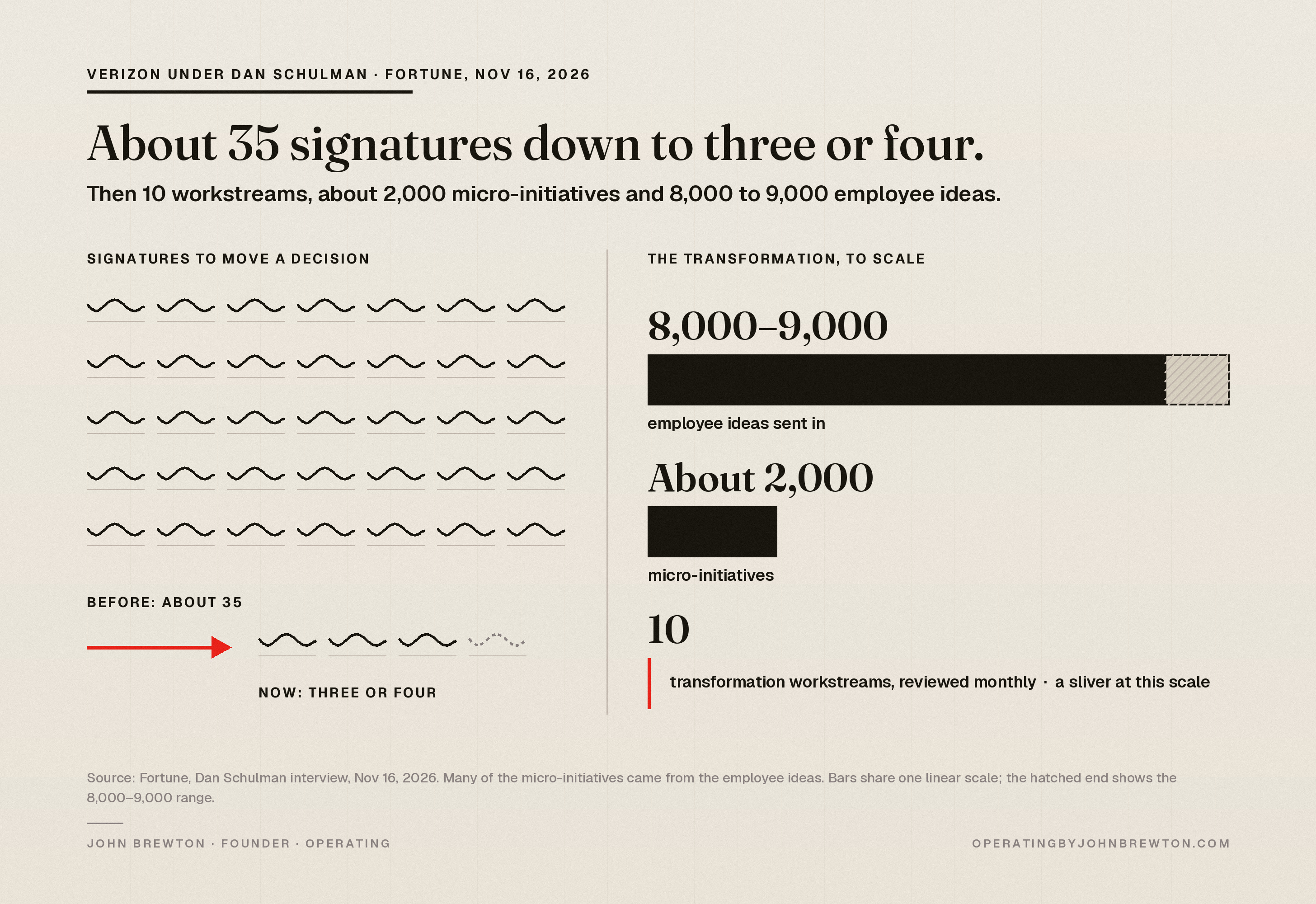
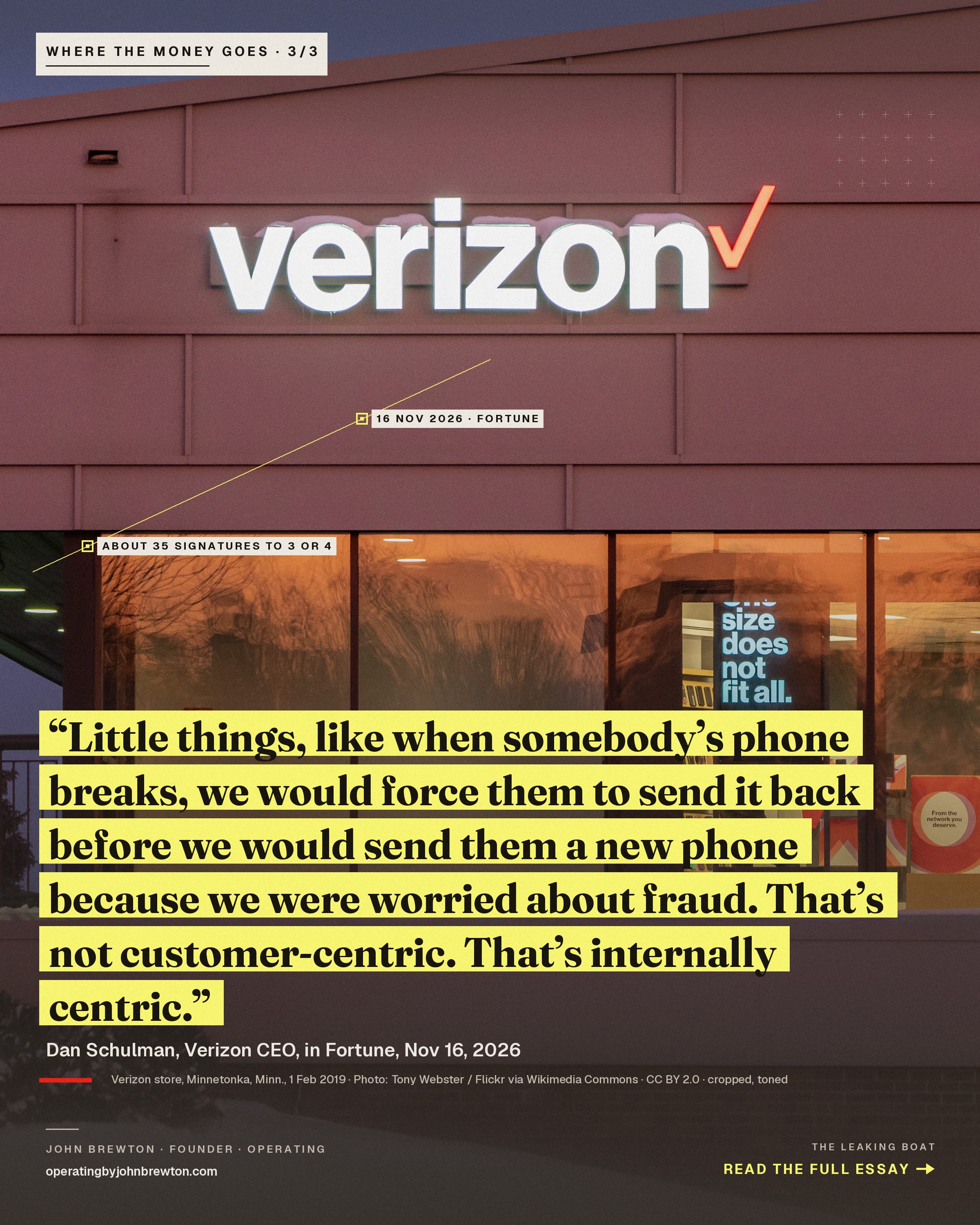
He set up 10 transformation workstreams. One of them is called “internal revolution,” aimed at what he calls the toxic processes that build up over the years. His example is small, and it’s perfect: “Little things, like when somebody’s phone breaks, we would force them to send it back before we would send them a new phone because we were worried about fraud. That’s not customer-centric. That’s internally centric.”
Think about who that rule protected. It was written to guard against fraud, and it left every honest customer without a phone while the broken one sat in the mail. Schulman now reviews all 10 workstreams every month, checking each one’s business case and when its metrics will hit. They manage about 2,000 micro-initiatives, many drawn from the 8,000 to 9,000 ideas employees submitted. He says he’ll judge his own three years on customer trust, through churn, customer satisfaction, and attach rates.
What ties them together
Each of these is a company taking a hard look at where its money and effort actually go. Berkshire found its capital flowing straight through to textile customers. Heinz was paying for a $600,000 table and a fleet of corporate jets. Verizon was spending signatures and customer patience to guard against fraud.
Chace and Morrison worked hard. Heinz executives worked long hours before 3G and after. Verizon’s people followed rules someone wrote for a reason. In every case, the change came when someone decided what the business should stop doing and then stopped it.
That’s the review I run with companies, and it matters most right now as we head into budget season. Before we talk about AI, new systems, or new hires, we walk through where the money, the approvals, and the hours go today. Most of it holds up, and some of it we stop.
If you’re building your 2027 plan and want to run this review on your own operation, I’d love to talk with you.
- j -
Become a Founding Member of Operating by John Brewton to book your first complimentary 60-minute 1:1 session with John and attend our weekly community Office Hours.

John Brewton documents the history and future of operating companies at Operating by John Brewton. He is a graduate of Harvard University and began his career as a PhD student in economics at the University of Chicago. Since selling his family’s B2B industrial distribution company in 2021, he has been helping business owners, founders, and investors optimize their operations.
Appendix: sources cited
From Operating - Operating by Warren & Charlie, Nov 28, 2025 - Workflows Eat Org Charts for Lunch, Apr 26, 2025 - Five Companies Just Showed Us Where AI Is Cutting Costs. Here’s How to Find It in Your Business., Nov 21, 2026
Berkshire Hathaway - Chairman’s Letter, 1985, Warren Buffett, dated March 4, 1986 - A Lesson on Elementary Worldly Wisdom as It Relates to Investment Management and Business, Charlie Munger, USC Business School, 1994, via Farnam Street
Heinz and Costco - Charlie Munger’s best quotes from Daily Journal’s annual meeting, Theron Mohamed, Business Insider, Feb 21, 2022 (meeting held Feb 16, 2022) - Squeezing Heinz, Jennifer Reingold, Fortune, Oct 10, 2013 - Heinz announces layoffs in Pittsburgh and Canada, Kevin Begos, AP, Aug 13, 2013 - Heinz cuts 600 jobs, Roger Riddell, Food Dive, Aug 13, 2013
Verizon - Verizon CEO Dan Schulman interview transcript, Fortune, Nov 16, 2026